Where Forgotten Films Dwell

Welcome to this site! It exists for one reason: to preserve the memory of films that have been forgotten about or under-appreciated throughout the ages. Take a seat, read an entry, leave a comment. You might discover your new favorite movie!

Saturday, July 28, 2012

Blogathon Schedule


Alright everyone! There's just a few days left until the My First Movie Blogathon! I just want to say really quickly that regular reviews at this site will continue immediately after the blogathon ends and the awards are handed out.

Here is the schedule.

August 1st
Stacia
http://shebloggedbynight.com/?p=323

Pat McDonnell
www.100yearsofmovies.net

August 2nd
Chris Michael
http://recentlyviewedmovies.blogspot.com/2012/08/my-first-movie-blogathon-pinocchio-and.html

Emma
http://letsmisbehaveprecodefilmtribute.blogspot.com.au/2012/08/my-first-movie-blogathon.html

August 3rd
Ivan Lerner
http://lernerinternational.blogspot.com/2012/08/lie-37-my-first-movie-caused-great.html

WB Kelso
http://microbrewreviews.blogspot.com/2012/08/my-first-movie-blogathon-ghostly.html

whistlingypsy
http://distant-voicesandflickering-shadows.blogspot.com/2012/08/a-silent-horror-on-summer-afternoon.html

August 4th
Alanhttp://www.greatmovieproject.blogspot.com/2012/08/my-first-movie-blog-thon-mary-poppins.html

Matt
http://matt-comicaltales.blogspot.com/2012/08/the-wizard-of-oz-buy-5-and-up.html

Alright everyone! August 5th will be the day we hand out awards!  We're going to be handing out 3 awards.  They will be voted upon by the participants. On August 4th everyone will email me their favorite 3 entries and I will tally them up for first, second, and third place.

See y'all then!

Wednesday, July 18, 2012

Marty

Directed by Delbert Mann
1955
The United States of America


Whenever I have conversations with friends about my favorite movies of all time, I find myself fumbling over my selections. It used to be so much easier back before I became a serious film buff. Now, the list seems to change every week. But despite all of my revisions, there is one film that always ranks among my favorites. That film is Delbert Mann’s Marty. The film starred Ernest Borgnine as Marty Piletti, a depressed and lonely thirtysomething butcher from the Bronx.  It always seems to catch people off-guard when I mention Marty alongside more famous classics like Stanley Kubrick’s Barry Lyndon (1975) and Akira Kurosawa’s Ran (1985). When pressed for an explanation, I usually chuckle and say, “Well, that film saved my life.” At that point, I usually manage to divert people’s curiosity by changing the subject. Most people assume that I’m joking. But the truth of the matter is that I am dead serious. Marty saved my life. In light of Borgnine’s death, I feel like sharing my story for the first time. This won’t be like my traditional Forgotten Classics of Yesteryear reviews. This article is about my personal relationship with a film that too many people have forgotten.

I have struggled with depression my entire life. The earliest I can remember feeling clinically depressed was around twelve years old. For four years I fought against a mental illness without the help of psychiatry or medication. The entire time I suspected that I was depressed, but nobody really believed me. It wasn’t that they didn’t care. The truth was as a child I had a tendency to be a drama queen. I overreacted to simple situations, threw tantrums over trivial problems, and generally made a nuisance of myself. So you can understand how people would be suspicious of claims that I might be depressed.

It wasn’t until I had my first panic attack that my parents took me to a doctor to get tested for clinical depression. For the next three years I bounced from one medical prescription and therapist to another with various degrees of success.  The lowest point of this era was when I was hospitalized in a clinic for mentally disturbed teenagers after a suicide attempt.  But then I graduated from high school and moved on to college. Things began to get better as I made new friends, but I was barely there for a few months before I had to be hospitalized a second time for trying to hurt myself. During this incident I had a mental breakdown so severe that I disturbed my dorm-mates. This resulted in my expulsion from the dorm. For the rest of the year I lived at home. Because I didn’t have a driver’s license, I had to be driven by my parents to and from my classes every day, a roundtrip that took two hours.

It was around this time that I started getting into movies in a serious way. A college film club’s screening of Kubrick’s The Shining (1980) sand-blasted my mind so severely that afterwards I knew that I had to make films. I started to watch as many films as I could. Sometimes I would watch 5-7 films a day. Of particular interest to me were the films that had won the Academy Award for Best Picture. I made a goal to watch as many Best Picture winners as I could. Eventually, I came to Marty, the 1955 recipient.

I immediately identified with Marty. He was working a dead end job, was over-weight, desperately wanted someone to love, but could never catch a break. There was a scene where Marty calls a friend that absolutely broke my heart. In one long, unbroken take, the camera slowly zoomed in on Borgnine’s face as he realized that the person on the other end of the phone wanted nothing to do with him. I’ve always found one-sided telephone conversations corny. But watch Borgnine’s face. Watch the disappointment. Watch his sad acceptance of a fate that, to him, seems inevitable. I’m not so sure if he was acting.

By the time Borgnine starred in Marty, he had already been in Hollywood for four years. During that time he had made a reputation as a mean tough-guy in such films as From Here to Eternity (1953), Johnny Guitar (1954), and Bad Day at Black Rock (1955). But Borgnine’s onscreen persona couldn’t be further than reality. A warm, likable fellow, he was the gap-toothed son of Italian immigrants and grew up during the Great Depression. He served 10 years in the United States Navy where he served in the Pacific Theater on-board the USS Lamberton. He only took up acting because his mother suggested it, reportedly saying, “You always like getting in front of people and making a fool of yourself, why don't you give it a try?”

And yet, this cheerful man was type-casted as a brute, as a thug, as a murderer. He was 38 years old when he starred in Marty. At that point, I wonder if Borgnine considered his career set in stone. That sad resignation permeates the film. And yet, Marty is always cheerful. He meets a lonely school-teacher who manages to see beyond his exterior. They quickly fall in love. However, everyone in Marty’s life, from his friends to his family, tries to talk him out of the relationship. Eventually, the bullying was too much and he stood her up.

In the film’s final moments, Marty sits at a bar in silence while his male “friends” lounge around, complaining about how there’s nothing to do. And then, something amazing happens. He yells a line that changed my life:

"You don't like her. My mother don't like her. She's a dog and I'm a fat, ugly man. Well, all I know is I had a good time last night. I'm gonna have a good time tonight. If we have enough good times together, I'm gonna get down on my knees and I'm gonna beg that girl to marry me. If we make a party on New Year's, I got a date for that party. You don't like her? That's too bad!”

And the film ends with Marty calling the schoolteacher.

I won’t claim that my life has been perfect since I first watched Marty. I’ve had many, many ups and downs. But I honestly believe that without Marty I wouldn’t be here today. That film did more to help me fight depression than any medication, therapy, or doctor ever has. It reinvigorated my life. Suddenly, suicide seemed insane. There was a schoolteacher out there for me, too. All I had to do was find her.

And I will find her.

And it’s all thanks to Marty and the eternal Ernest Borgnine.

Rest in Peace.

Saturday, July 7, 2012

Christmas in July

Directed by Preston Sturges
1940
The United States of America


It begins, like so many other great stories, with a misunderstanding. Well, perhaps more of a deception in this particular case. Jimmy MacDonald is a run-of-the-mill office worker who can’t keep his mind on his work. All day long he doodles “$25,000” on office stationary and fumbles his receipts. For although MacDonald is just another office lackey, he dreams of much, much more. He has recently entered the Maxford House Coffee slogan contest which boasts a grand prize of $25,000. MacDonald considers himself a shoe-in to win. The problem is that nobody else understands the pure genius of his slogan. Even his girlfriend Betty Casey doesn’t get it. But how could she not understand such a brilliant piece of marketing genius: “If you can’t sleep at night, it’s not the coffee, it’s the bunk.” See? It’s a play on words!

 Jimmy MacDonald and Betty Casey

Well, MacDonald ends up getting the last laugh, let me tell you! One day he finds a telegram on his desk. What’s on this telegram, you ask? Why, nothing less than an announcement that he has won the grand prize along with a check for $25,000! See, what did I tell you?

MacDonald just heard the happy news.

But MacDonald’s good fortune doesn’t end there! He gets promoted to advertising executive with his own office! He goes on a lavish shopping spree at Shindel’s department store, buying gifts and toys for all of his neighbors and their children. He even picks out a futuristic sofa for his mother! You should see this thing. It turns into a bed with the press of a button!


 It's the bed of the future!!

There’s only one small problem. See, it turns out that a winner hasn’t been chosen in the Maxford House Coffee slogan contest. The jury is deadlocked. They never sent a telegram to a Mr. Jimmy MacDonald. They don’t even know who Mr. Jimmy MacDonald is. And they certainly didn’t send him a check for $25,000. That telegram and check on his desk? Well, that was put there by a couple of MacDonald’s co-workers as a practical joke. Things got out-of-hand too quickly for the pranksters to come clean. So when Dr. Maxford, the owner of Maxford House Coffee, finds out that somebody has “won” the contest, it becomes all too clear that things are going to go sour very, very quickly. But...not quite yet.


This has all been the set-up for Preston Sturges’ second directorial effort, Christmas in July. Fresh off his Oscar-winning success with his first film, The Great McGinty (1940), Sturges continued to establish himself with Christmas in July as one of the most brilliant writer/directors of the 1940s. Though it barely clocks in at over an hour, Christmas in July is one of Sturges’ most memorable, and perhaps one his most criminally under-appreciated, films.


Christmas in July was early enough in Sturges’ career that it still retained a kind of wide-eyed enthusiasm and belief in the inherent goodness of mankind. Prolonged studio battles and box office failures would eventually drain Sturges to the point of cynicism, a trait that becomes increasingly apparent later in his career with such films as Unfaithfully Yours (1948). But Christmas in July’s optimism was characteristic of the times. The later years of the Great Depression may have been an unparalleled time of suffering in American history, but it produced some of the most upbeat and hopeful films ever made. It was a time when 60-80 million Americans went to the movies every week.  This was the era of the Marx Brothers, W.C. Fields, idealistic Capra-esque heroes, and Busby Berkeley excess.


But while Groucho indulged in comedic anarchy and Berkeley in costumed extravagance, the most excessive part of Sturges’ films was the dialogue. Sturges had a talent for lightning fast and witty dialogue and the ability to cram three hours worth of it into a single feature. Much of his writing is so good that it goes over your head until you really sit down and think about it. Take MacDonald’s slogan: “If you can’t sleep at night, it’s not the coffee, it’s the bunk.” That turn of phrase sounds like the last half of a badly translated zen kōan. MacDonald came up with it after he read a medical journal by a Vienna scientist who claimed that coffee puts people asleep instead of keeping them awake. So, MacDonald figures, if you can’t fall asleep after drinking Maxford House Coffee, it must be the bunk that you’re sleeping on that’s keeping you awake!


Like I said, MacDonald’s slogan makes no sense whatsoever. But he believes in it so passionately that the audience begins to believe it, too.  And that’s what keeps the plot going: a willingness to go along with sheer enthusiasm. Dr. Maxford should have realized something was up when MacDonald’s check for $25,000 bounced. But instead he just insisted that he would cover it when the bank called. The Shindel department store should have been more suspicious when a random man walked in and went on a spending spree with a strange check. And MacDonald? Well, he shouldn’t have been so self-deluded as to think that his slogan had any chance of winning.


But much like Sturges’ own ambitions, Christmas in July is a film about impossible dreams coming true. It is a pure distillation of what made Sturges’ films so great: hysterical writing, sincere acting, and genuine heart. It affirms that American belief that if you work hard enough (and have a little luck) you can achieve anything. All we need, as Betty said, is a chance. Just...a chance.

Sunday, July 1, 2012

2012 BLOGATHON ANNOUNCEMENT

Ladies and Gentlemen!
Forgotten Classics of Yesteryear is proud to announce that it will be hosting another blogathon this August!


That's right! This year's blogathon topic is My First Movie. Everyone has a "first movie." It can be the first time your parents took you to a movie theater as a child. Or maybe the first time you were watching a film on television and you realized that this was something much, much more than the regular everyday programming. This blogathon is devoted to our first memories of watching movies. You can talk about the movie itself if you want, but the focus should be the actual experience of watching a movie for the first time. This topic is open to interpretation. Maybe you could write about the film that first made you realize that you loved the cinema. Who knows?!

If you would like to participate, email me at nch257@nyu.edu and provide me with your:
-Name
-Topic
-Preferred Date
-Website

If you don't have a website but would still like to participate, then send me an email anyway. We'll figure something out.

I look forward to reading all of your memories. Don't forget to advertise the blogathon by posting the banner overhead on your site. And please, tell your friends!

See you August!

Editor-in-Chief
Nathanael Hood

Friday, June 29, 2012

Park Row

Directed by Samuel Fuller
1952
The United States of America


“Every newspaperman is a potential filmmaker. All he or she has to do is transfer real emotion to reel emotion and sprinkle with imagination.” - Samuel Fuller

In a smoky, sticky pub off Park Row, New York City, close-up on Phineas Mitchell as he nurses a drink and pours over a newspaper. Tracking shot across the crowded bar where exhausted newspapermen squeeze side-by-side for a tall mugs of beer. Back to Mitchell. Close-up on newspaper: CHARLES MOTT EXECUTED: FIRST HANGING IN NEW-YORK IN THREE YEARS: DESERVES FATE HE GOT. Close-up on Mitchell and another newspaperman. “The story really bothers you, doesn’t it?” “Yeah.” “What are you gonna do about it?”


Scene change to later that night. Medium shot of Mitchell, Davenport, and two other newspapermen. Gotta squeeze them together so they all fit in the 1.37:1 aspect ratio. “It’s no good writing anything if you haven’t got a paper to put it in.” “Know what I’d do if I had a paper?” Slowly zoom in on Mitchell. “First thing I’d do is christen it. I’d call it the Globe. I’d make it the best newspaper on Park Row, that’s what I’d do.” Tracking shot across the bar to all of the newspaper men staring at Mitchell in awe. Close-up on Mitchell and the elderly Charles A. Leach. “Mr. Mitchell, for three years every night I’ve been listening to what you’d do if you had a newspaper...I like it very much...All my life I’ve wanted to be what you are: a newspaperman. What you can do, I can’t. What you need, I’ve got...I’ve got a good steam press...I want to go into partnership, Mr. Mitchell. You’d be editor and publisher of the newspaper...I’ll handle the business end.” “You mean a paper of my own?” “You run the paper the way you want to run it and answer to no one...Is it a deal?” “Yup.” “You’ve got yourself a newspaper.”


Scene change to medium long-shot as Mitchell leaves the bar. Tracking shot as he walks along a 4 story replica of Park Row, dodging horse-and-carriage, ending on statue of Benjamin Franklin in right foreground, Mitchell in left background. Medium-close up on another nearby statue. Vertical pan down to plaque at base of statue: HORACE GREELEY: FOUNDER OF THE NEW YORK TRIBUNE. Cut to medium long-shot with Greeley in foreground, Mitchell in background. To the statue, “We’re in business.”


These scenes from the first fifteen minutes of Park Row set the tone of what would be director Samuel Fuller’s most personal film. A love letter to the birth of modern American journalism at the turn of the nineteenth century, Park Row is perhaps the purest crystallization of Fuller’s bombastic, hard-boiled style.  The film, shot in only sixteen days, was produced, written, directed, and totally self-financed by Fuller. Though destined to be a complete flop, Park Row demonstrated Fuller at the height of his skill and irrepressible energy. Fuller would later comment, “Goddamnit, Park Row was me!”


Before becoming a director, Fuller had been a newspaperman similar to the ones he immortalized in Park Row. He went from selling newspapers on sidewalks to working the beat as a crime reporter for the New York Evening Graphic. It was during these years that Fuller’s skills as a storyteller began to take shape and form. He developed a knack for exaggerating scenes and moments to display earth-shattering emotions while not going over the deep-end into self-parody. He learned to keep a story lean, mean, and simple while not totally abandoning its crucial human element. When he began to write screenplays, he wanted “to use the screen as a newspaper.” And so arose Fuller’s ultra-kinetic, to-the-point visual style.

 
Take, for instance, a phenomenal scene later on in Park Row. Having set up his newspaper, The Globe, Mitchell was quickly gaining new readers and powerful enemies. One such enemy was Charity Hackett, the rich, beautiful, and unscrupulous publisher of a rival newspaper that Mitchell used to work for. After several attempts at subtly sabotaging Mitchell’s newspaper, she finally instructs one of her henchmen to close him down.

 Charity Hackett in right foreground.

And so, late one night, Mitchell is called from his office by employees claiming that men are tearing apart their newsstands. In one long, expert tracking shot, Mitchell runs down the street and savagely attacks the goons tearing them apart. The use of the tracking shot highlights and intensifies the emotion and human drama of the scene.


Another part of Fuller’s use of “creative exaggeration” involves interweaving different, seemingly unrelated historical moments into his narrative. One of Mitchell’s employees invents a steam-powered printing press. The erection of the Statue of Liberty becomes The Globe’s cause célèbre. All of these are mixed with smaller scenes detailing various aspects of the newspaper production process. This involves a scene with a lightning-fast illiterate type-setter which produces one of the film’s best lines, “The day you learn how to read, you’re fired.” Fuller turns The Globe into a living, breathing microcosm.


Park Row may not be the most historically accurate or streamlined film, but like a great newspaper story, it’s engaging, entertaining, and even informative. It’s an ode to the tireless search for journalistic truth. But Fuller is wary of yellow journalism. One of the film’s maxims is “the press is good or evil according to the character of those who direct it.” A year before Park Row was released, Billy Wilder directed another drama about journalism entitled Ace in the Hole. The film was about a vicious reporter who turns a mining accident into a media circus for his benefit. It is a cynical look into the dark side of American journalism. In the past few decades, Ace in the Hole has become a classic. After all, in this age of 24-hour news cycles and punditry it is easy to identify with pessimistic outlooks concerning the press.  But perhaps critics and audiences should take another look at Park Row. Perhaps we should remember that not all journalists and news editors are jackals or political puppets. After all, the freedom of the press is one of the cornerstones of America. We should glorify stories about the people who defend it with their lives, not the ones who pervert it.

Saturday, June 23, 2012

Stranger on the Third Floor

Directed by Boris Ingster
1940
The United States of America


The true soul of film noir isn’t found in shadowy offices, tough private eyes, and deadly femme fatales. Many have made the mistake of believing that film noir is simply a style. It is true that as film noir became popularized overseas by European critics a certain aesthetic became associated with the genre. But the reason why these critics began to associate certain movies as film noir has to do with their plots and focus on the psychological status of their characters. Film noir isn’t the detective walking lonely streets, but the internal monologue bouncing around his head as he tries to separate friend from foe. Film noir isn’t the dark alleyways, but the deviants and crooks who hide in them. And finally, film noir isn’t about amorality, but about moral people trying to make sense of an amoral world. For instance, Boris Ingster’s Stranger on the Third Floor focuses on two happy, law-biding citizens who are trying to build a life together. But these two citizens find themselves caught up in the middle of a horrific situation that twists their minds to the breaking point. It is from this simple story that one of the first truly great film noir is borne.


 The film begins in a lively diner where a young reported named Michael Ward meets his long-time girlfriend Jane for breakfast. Ward happens to be a key witness in a murder trial for a small time criminal named Joe Briggs who was accused of killing a cafe owner named Nick Giuseppe. His eyewitness testimony is instrumental in Briggs’ conviction and sentencing to the electric chair. Ward thinks little of helping send a man to the electric chair. Because of this break, he was awarded a $12 a month raise and a byline for his newspaper. Ward sees this as the perfect opportunity to get married to Jane and to buy a house.


However, Jane is extremely uncomfortable with how he managed to get ahead by helping someone convicted of murder. After he was sentenced, Briggs screeched out that he was innocent over and over again. Jane was mortified by what she saw and consumed by anxieties over the possibility of his innocence. So she badgers Ward about her fears. At first he is dismissive. But then thoughts of wrongful persecution, conviction, and execution begin to haunt his thoughts and dreams.


In one of the film’s most magnificent sequences, Ward has a nightmare where he is accused of a crime he didn’t commit. We witness a dazzling collage of hyper-stylized vignettes: reporters obfuscated by giant newspapers declaring his guilt, Jane committing suicide, a trial where Briggs mocks him when he is declared guilty, and a choreographed escort to the electric chair.


 This sequence was shot by German expressionist cinematographer Nicolas Musuraca who would later go on to film such masterpieces as Out of the Past (1947) and Clash by Night (1952). In fact, the cinematography in this scene encapsulates Stranger on the Third Floor’s breath-taking visual style. Unlike many other film noir which tended towards naturalistic cinematography enhanced by hard lighting and striking shadows, Stranger on the Third Floor features an astonishing inventory of expressionist filming techniques. There are oblique camera positions, dutch angles, dissolves, voice-overs, extreme shadows, and even exaggerated props.


These techniques all help create an atmosphere of suffocating dread and torment which is only magnified when Ward finally wakes up to discover that one of his neighbors isn’t snoring anymore. See, Ward lives in a tiny apartment building with paper thin walls. One of his neighbors, an irascible old codger, has a chronic snoring problem. The man had repeatedly called the authorities to Ward’s apartment for the slightest violations of the complex’s rules, such as typing on a typewriter after dark. He had annoyed Ward so miserably that he had snapped and threatened to kill him. But it had all been hot air. But when Ward awakens to a silent apartment building, his worst fears are confirmed: the man has been murdered. One thing leads to another and Ward finds himself arrested for a crime he didn’t commit.


What sounds like a predictable plot twist is delivered quite unexpectedly. After Ward’s neighbor is found dead, it is Jane who convinces him to go to the police and explain that  he found the body. After all, Jane reasons, if Ward was the killer, why would he so readily go to the police? But when the police discover that he was the key witness in Briggs’ trial, they begin to wonder why he was the first person to discover the dead body in both instances. But still, Ingster misleads the audience by having Ward interrogated by a sympathetic police detective. And then, suddenly, Jane gets the message that he has been arrested. Ingster’s decision to not show Ward’s arrest and instead only inform the audience of it via Jane throws the entire police and justice system into question. It comes as an assault to our senses and better judgment...much like a wrongful conviction would to an innocent man.


There is only one thing that can clear Ward’s name: a strange, little man who recently moved into his apartment building. Ward swears that he saw him before...possibly the night Giuseppe was murdered. So Jane sets out to find this mystery man.  The problem is that nobody can seem to remember him. That is, at least, until she accidentally stumbles upon him muttering to himself about things best left unsaid. Peter Lorre delivers one of his career’s greatest performances as this toad-like creature. What is even more impressive is that he manages to do so with less screen-time than he did as Hans Beckert in M (1931). Lorre manages to create a character that carefully teeters on the edge of insanity without becoming outright maniacal. Watch how he delivers his monstrous lines as casually as one would discuss their dry cleaning. There is a certain intensity, a kind of hatchet-behind-the-back apprehension that engulfs him much like Anthony Perkins in Psycho (1960), Anthony Hopkins in The Silence of the Lambs (1991), and Heath Ledger in The Dark Knight (2008). In hindsight, it is a blessing that Lorre was featured so sparingly in Stranger on the Third Floor. If they had used him more, it would have ruined his character.


Most film critics and historians point to John Huston’s The Maltese Falcon (1941) as the first authentic film noir. However, Stranger on the Third Floor should be lauded as the rightful recipient of that honor. More than any other film of its time, it zeroed in on what truly defines the genre: substance, not style.

Saturday, June 16, 2012

The Set-Up

Directed by Robert Wise
1949
The United States of America


In his autobiographical account of his childhood as a young boy growing up in Cleveland during the 50s entitled The Quitter, Harvey Pekar recounted how he fell in love with the sport of boxing. The son of Jewish immigrants from Poland, Pekar admired how many successful Jewish boxers were able to become superstars despite racial prejudice. But after awhile, he began to notice something about the boxers that he looked up to. He wrote, “I didn’t know much about Jewish boxers, but they got into the sport when they were recent immigrants and didn’t have much money. Then got out in the 1940s with the coming of better economic opportunities. This indicated that they weren’t in love with boxing, just wanted to use it to make a living until something better came along.” That’s part of the majesty of boxing films: the best ones aren’t about people who love to box. They are about people who have to box.


Rocky Balboa had to prove to himself that he could go the distance. Jake LaMotta used boxing as an affirmation of his own insecurities surrounding his masculinity and self-image. Maggie Fitzgerald saw boxing as a means to escape her exploitative family and her own blue-collar purgatory. But what about Stoker Thompson, the working class hero from Robert Wise’s The Set-Up? What does he want? The man has been a boxer for most of his adult life. He’s 35 years old, hasn’t won a fight in years, and is scheduled to have a match against the rising superstar Tiger Nelson. Everyone expects him to lose. In fact, there are many who want him to lose. Stoker knows that this could very well be his last fight. So why does he box when the odds are so impossibly stacked against him? 


Maybe it’s to escape the world that he inhabits. Stoker’s city is a tangled mess of dark alleyways and slums. Everyone is sweaty and greasy.


Only the local mobsters seem to have clean, unstained shirts. The masses who attend the matches aren’t much better, either. Rowdy off-duty sailors, disheveled businessmen, made-up streetwalkers clutching to their latest customers, and fat louts balancing hot dogs on their enormous guts call for blood.  


The locker rooms where the various fighters prepare for their bouts reeks of desperation. Utilizing a real time narrative structure three years before it was popularized in High Noon (1952), the film keeps the audience largely contained in these lockers as they watch fighters get called up one-by-one for their fights. A young kid triumphantly rejoins his comrades after winning his very first fight in the wake of a minor nervous breakdown. 


An enthusiastic older boxer with a cracked face only a couple of matches from hitting the big-time returns so badly beaten that he is rushed to the hospital. 


Maybe it was here that Stoker found his motivation. But, maybe it was his wife, Julie. While Stoker prepares for his fight, she walks the mean, grimy streets around the boxing center. She hates that her husband has to fight. She’s tired of him being humiliated and used by the boxing industry. Stoker wants to make good so he can support them in the future. But Julie has begun to wonder if it is worth it. In a fantastic scene, she walks by a store with the radio turned on to the boxing matches. She hears that a boxer has just been brutally defeated, and her heart sinks. But then it is announced that this boxer was not Stoker and that his fight is coming up soon. Watch her relieved realization. At that moment, the spark of hope filled her heart.


Whatever Stoker’s reasons for fighting, one thing he didn’t count on was that everyone was counting on him to lose. His manager, Tiny, has made an arrangement with the mob for Stoker to take a dive. The only problem is that he never bothered to tell Stoker. He fully believed that Stoker would lose on his own. But he didn’t expect for Stoker to go for the glory one last time.


The Set-Up is a glorious film and one of the very best examples of the boxing sub-genre of film noir.  This isn’t a film about boxing, per say. The Set-Up is a lyrical poem about broken dreams and impossible goals. Stoker is played by that reliable stand-by of B-grade film noir, Robert Ryan. This film was made just five years after he had been a drill instructor in the United States Marine Corps. So not only is Ryan’s performance filled with emotional and psychological pathos, he looks like a man who has been battered, beaten, and abused for years.


I mentioned that The Set-Up isn’t as much a boxing film as a psychological character study. But that doesn’t mean that the film doesn’t contain some of the best fighting footage ever featured in the genre. Ryan fight scenes are particularly authentic, probably in no small part to his being a boxing champion while studying at Dartmouth college. But more importantly, the fights aren’t just random flurries of punches and jabs. There’s a rhyme and rhythm to the fighting like a ballet. Each round of Stoker’s fight becomes symbolic of him overcoming his personal demons and doubts. 


A word about the ending. Few times have I ever seen a film have an ending that was sad and uplifting at the same time. Don’t mistake that with an ending being bitter-sweet. The Set-Up ends with triumph and loss, punishment and salvation, humiliation and acceptance. This is a story about a man, after all...a man with everything to lose and nothing to win, except his own dignity.

Friday, June 8, 2012

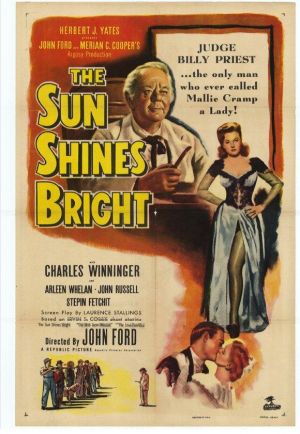
The Sun Shines Bright

Directed by John Ford
1953
The United States of America


Who was John Ford? The legendary Hollywood director was a mess of seemingly impossible contradictions.  The man who would become so closely identified with the Western genre was born in Maine as the son of Irish immigrants. While he helped redefine the depiction of Native Americans in such films as Cheyenne Autumn (1964), he rode as a Klansman in D. W. Griffith’s The Birth of a Nation (1915).  The same man who directed such ground-breaking progressive masterpieces as The Grapes of Wrath (1940) was instrumental in the casting of Stepin Fetchit, a very close friend, in many of his films. While he valued the institution of the family more than almost anything else in his films, in real life he was an absentee father and husband. At times staunchly conservative and at others unapologetically liberal, his political and social outlooks on life could change on a whim.  He was a kind, sensitive man who perpetuated the image of an angry perfectionist authoritarian out of fear that others would take advantage of him.  While he claimed to not give a damn about what other people thought about him and his work, his fear of being rejected would lead him to heartbreaking alcoholic breakdowns in between film productions. So I ask again, who was John Ford?

For a man who tried so hard to make an enigma of himself, the clearest picture of who Ford truly was can be partially glimpsed in his beloved films. But which film best represents Ford? I would answer a little known film from 1953 entitled The Sun Shines Bright. Ford described later in his life that it was “really my favorite, the only one I like to see over and over again.” Made following the tide of studio goodwill borne from the unexpected success of The Quiet Man (1952), the film is essentially a morality play about an elderly judge in a tiny Kentucky town in the twilight years of the 19th century. Based on three short stories by Irvin S. Cobb, the film revisits the character of Judge Priest, previously portrayed by Will Rogers in Ford’s film of the same name from 1934. Though Ford re-adapted some of the same material from his earlier film in The Sun Shines Bright, he was given a much wider berth of creative freedom.  The result was perhaps Ford’s most emotional and personal film.

It begins with a series of vignettes that form a picture of the town of Fairfield, Kentucky. We watch Judge Priest and his servant Jeff Poindexter (Stepin Fetchit) preside over a trial involving U.S. Grant Woodford, a black teenager who won’t work to support his relatives, that ends with a grimace-inducing impromptu performance of “Dixie.”  A meeting of Confederate veterans is held where they give a solemn and heart-felt eulogy to a Rebel Jack after dutifully saluting the Union flag. When a nearby gathering of Union veterans asks them to return the Union flag that they borrowed for their ceremony, Priest serves as an honorary color guard. Of course, once in the presence of the Union veterans he wastes no time to remind them that he is coming up for re-election.  Soon certain class and racial divisions are established: the well-to-do white folk, the Temperance League and their 200 votes (i.e. husbands), the subservient blacks, and the Tornado Boys, a large informal gang of backwoods hunters and trappers. But everything is pleasantly idealized. This is the South as envisioned by wistful romantics.


But the film’s early comedic tones soon take a turn for the worse. An old prostitute shows up, collapses, and dies in a local bordello. She is soon revealed to be the disgraced and disowned daughter of General Fairfield, the much revered and beloved local Confederate leader.  Meanwhile, Woodford has been arrested and wrongfully accused of raping a local girl. The enraged Tornado Boys begin to gather near the prison in order to lynch him. And finally, Priest’s chances to win the election become severely challenged by Horace K. Maydew, the “son of a carpet-bagger from Boston,” who seeks to destroy Fairfield’s idyllic community by forcing it into the future.  


With the town of Fairfield ready to rip itself asunder, the ailing Judge Priest must step in one last time to try and maintain the peace. Priest represents one of Ford’s favorite character archetypes: the reluctant patriarch. Just like in She Wore a Yellow Ribbon (1949) and The Quiet Man, The Sun Shines Bright revolves around an aging male authority figure who finds himself drawn one last time into a terrible conflict to preserve peace. These men are presented as relics of a bygone age who nevertheless must serve as a moral compass for younger generations. And, indeed, Judge Priest is considerably worse for wear. Despite Stepin Fetchit’s painfully hokum performance as Jeff, it is clear that Priest relies on him, and not the other way around. Priest is a rampant alcoholic who regularly uses the excuse “Jeff, I gotta take my medicine - I gotta get my heart started” to sneak off and take a massive drink from a hidden cask. He projects an aura of strength and vitality while courting voters...but it’s a sham. Priest is a tired, tired old man.

And yet Priest will not stand idly by and watch his beloved Fairfield destroy itself. He grabs a gun and single-handedly prevents the Tornado Boys from lynching Woodford (Ford had previously tried to incorporate this scene in Judge Priest, but it was cut by the studio). Afterwards, he shames the entire town by marching behind the white hearse holding General Fairfield’s daughter. This scene is easily one of the most powerful in Ford’s entire career. The town of Fairfield had tried to ignore the poor woman’s fate due to her lowly social status. But Priest marches right behind her fellow prostitutes in her funeral procession. Then, slowly, the rest of the town follows suit until over a hundred march with Priest. The procession leads to a black church where Priest delivers an earth-shaking sermon. And then, finally, in the middle of the service, General Fairfield enters the church to see his daughter one last time.


To say that Priest’s actions were controversial would be to criminally understate it.  His prevention of the lynching may have further endeared him to the black community, but it potentially lost him hundreds of vital votes from the Tornado Boys.  Respecting General Fairfield’s daughter may have been the righteous thing to do, but it disgraced him in the eyes of the community’s more unforgiving sectors. As Jeff mournfully notes, “Me ‘n’ the judge sho’ ain’t gonna get elected now.”

But then a miracle occurs.

On the day of the election, when Maydew seems guaranteed to win, the Tornado boys rally en masse and vote for Priest, securing his victory. Later that night, the entire town passes Priest’s front porch in review. Every social group is represented: Confederate veterans, Union veterans, Temperance League, Tornado Boys (holding a banner reading “He Saved Us from Ourselves”), and finally the blacks who are given a position of honor by marching at the very end in the opposite direction.  The film’s final shot has Jeff playing “My Old Kentucky Home” on the harmonica on Priest’s front porch. The 20th century and progress may soon arrive, but for tonight peace and balance has been restored to the town of Fairfield.


Of course, as any modern viewer will tell you, everything is not alright in Fairfield. Segregation remains the unwritten rule. The few blacks who have any screen-time are of the “yessuh” and “nossuh” variety.  The Confederacy is romanticized and fiercely defended by primary characters. Fairfield is quite obviously a white-washed charade. But look a little deeper. Ford isn’t romanticizing segregation or social inequality. He is obsessed with the idea of an ordered society founded on principles of justice and honor led by men who aren’t afraid of shattering taboos. Quite simply, Ford is Judge Priest and the cinema is Fairfield. By the time he shot The Sun Shines Bright, Ford was already tiring of the Hollywood establishment. As he stated in a 1953 interview, “I don't want to make the kind of junk the screen is offering today, because we made those pictures better thirty-five years ago.” The cinema that Ford loved was disintegrating right before his eyes. And so Ford endeavored to make intensely personal films like The Sun Shines Bright to help restore Hollywood to its former glory. One can almost imagine John Ford standing in Judge Priest’s shoes in the final scene with a legion of producers, screenwriters, actors, and directors holding a banner reading “He Saved Us from Ourselves.” And that is why The Sun Shines Bright is one of the best explorations into Ford’s mind. For just a moment we see the man that Ford truly wanted to be: venerated, respected, and loved by everyone. What he was too scared to achieve in real life he replicated on screen. 

Sunday, May 6, 2012

May Day!! May Day!! We're Going Down...Temporarily!!

Yes folks...once again this humble blog must go on hiatus. This time I will be MIA from the blogosphere for the entire month of May.  I thought that I could juggle this blog and my personal life...but I was mistaken. I have three final papers to write in the next two weeks AND I'm going to be temporarily moving from New York City to Santa Cruz, California. May is going to be an insanely busy month. I just simply won't have the time to write reviews for this site. It break my heart, but that's how it goes. But this site is far from dead, people. When June comes along, I'll be back with brand new reviews! So until then, KEEP CIRCULATING THE TAPES!!

Editor-in-Chief
Nathanael Hood

Friday, April 20, 2012

Visioneers

Directed by Jared Drake
2008
The United States of America


“This world is a comedy to those that think, a tragedy to those that feel.” - Horace Walpole

George Washington Winsterhammerman hasn’t felt happy in quite some time.  Oh sure, he has a enviable life.  After all, he has a decent job as a Level Three “TUNT” employee at the Jeffers Corporation, the single largest business in world history which simultaneously maintains de facto control over the United States government.  He has a lovely wife, a son, and a massive single family home in the suburbs.  As his name suggests, he is even a descendent of the original George Washington, leader of the American Revolution and the first President of the United States.  But despite all of these things, George Washington Winsterhammerman isn’t happy.  Even worse, he has begun to have dreams when he goes to sleep at night.  And everyone knows that having dreams is the first sign that you might explode.  See, over 100,000 people have spontaneously exploded for no apparent reason.


George Washington Winsterhammerman


George has recently seen a doctor to investigate if he was in danger of exploding, but he was given a clean bill of health, relatively speaking.  As the doctor said, “Mr. Winsterhammerman, you seem like someone who’s able to follow orders well, you have a desire to please, you’re a pleasant, affable sort of fellow who doesn’t seem to want much, perhaps just to be included.  Judging from the somewhat dull look in your eyes I would rate your intelligence at ‘average.’  All of which is good.”  So George Washington Winsterhammerman has everything going in his favor. And yet, he dreams.


Such is the world of Visioneers, the first film by writer-director team Brandon and Jared Drake.  The film has been advertised as a black comedy, but I think to do so would be disrespectful.  Visioneers is so much more than just a comedy with black humor.  Instead, it is a devastating examination of the relationship between tragedy and comedy. Many like to imagine a line, however thin, between the two. But I’ve begun to doubt that comedy and tragedy are two different things.  The thought first occurred to me when I recently re-watched Charlie Chaplin’s The Gold Rush (1925), arguably the greatest blend of laughter and tears ever committed to the screen.  In the famous bread-roll dance scene, I couldn’t figure out whether to laugh at Chaplin’s antics or weep at the cruelty of the women who tricked him.  I frequently felt the same emotion while watching Visioneers.  On the one hand I wanted to laugh at the scenes that demonstrated the complete absurdity of George’s world.  Who wouldn’t laugh at a society where flipping your middle finger and saying "Jeffers morning" was a standard greeting?

 "Jeffers morning, everyone."

George’s wife watches a show where women discuss how the use of “vaginal butter” and the ownership of 12-gauge shotguns are the keys to staying happy!


On the ride home from work, George is serenaded by radio commercials with such infectious jingles as:

If you wanna be happy and have lots of friends,
Eat fried chicken, fried chicken makes a difference.
And if you wanna have fun and not blow to pieces,
Eat fried chicken, fried chicken, it’s delicious!

 
Can't argue with that logic. 

And yet, all of the laughter makes one feel nervous and uncomfortable.  It’s very clear that George lives in a truly hellish society where genuine emotions and feelings are repressed and replaced by kitschy, artificial substitutes such as television, consumer goods, and blind loyalty to the Jeffers Corporation.

Say hello to Mr. Jeffers.

When George’s brother Julieen, a former Level Five employee, moves into his pool-house after quitting his job, we view him as an amusing oddity despite the fact that he is clearly the only person we’ve seen who is actually happy and content with his life. His achievement of what we as the viewers view as normalcy make him an outsider.  In another scene, to combat the increase of explosion cases the Jeffers Corporation forces its employees to wear silly outfits and hug giant teddy bears.  At first, we laugh. But when one of George’s co-workers has a particularly violent reaction to the overstuffed animals, our hearts sink into our stomachs.  Yes, there is humor in this world.  But it comes at the expense of its occupants’ very humanity.

Let's just say that what happens next isn't pretty.

Eventually George seeks solace in the form of his ex-boss Charisma who was suddenly fired.  He discovers her working in her father’s cafe in an “undeveloped” part of the country.  They find a glimmer of hope and happiness in each other.  But the powers that be conspire to try and keep them apart.  From there George’s world continues to collapse.  Julieen is violently taken into custody by government agents. The government suddenly declares explosions as a “threat to our way of life” and begins a campaign to install thought inhibitors into all of its citizens.  These inhibitors are, of course, manufactured and distributed by the Jeffers Corporation.  Media personalities start to blow up during live broadcasts. In one of the film’s most devastating scenes, George and his wife witness the “vaginal butter” lady suffer a mental breakdown when she learns that she has been instructed to tell people that “happiness is being happy.”

 
I won’t reveal what happens in the last few scenes because I believe that it is something that you have to experience for yourself.  I won’t even say if it’s happy or sad.  You need to see it with your own two eyes.  It is the perfect conclusion to the Drake brothers first film.  I praise a lot of films as part of my job as a movie critic.  As such, I can say that some films have better acting than Visioneers, although Zach Galifianakis’ performance as George would have easily earned an Oscar nod if it had gained a wider release.  Some films have better cinematography.  And some films demonstrate a greater level of craftsmanship.  But despite this, Visioneers is truly something special.  Since first watching it, the film has haunted my dreams and occupied my fantasies.  There is something so basic, so primitive, and so pure at the heart of Visioneers that it stands in a league of its own.  Most Oscar winners wish that they could claim the same.