Where Forgotten Films Dwell

Welcome to this site! It exists for one reason: to preserve the memory of films that have been forgotten about or under-appreciated throughout the ages. Take a seat, read an entry, leave a comment. You might discover your new favorite movie!

Friday, November 25, 2011

Dogma

Directed by Kevin Smith
1999
The United States of America


At some point during the history of American cinema, the predominant view of organized religion, in particular Christianity, seemed to shift. Up until around the 70s, organized religion was treated positively. Early Hollywood cinema is full of heroic priests and clergy. Prominent examples include Father Jerry Connolly (Angels with Dirty Faces), Father Charles O’Malley (Going My Way), and Father Barry (On the Waterfront). Faith was depicted as something to cherish and respect. Who can forget the scene from Captains Courageous when Manuel Fidello (played by Spencer Tracy) wistfully recounts his personal beliefs and convictions? But, as I said, at some point, the predominant view of religion within the cinema became ugly and negative. Organized religion was seen as a tool used to subjugate the masses, priests were seen as ignorant fools (and more recently, child molesters), and it became a badge of honor for many characters to abandon their faith. Think I’m joking? Try this: name five clergymen from mainstream American movies of the last decade who were not depicted as: a) a moron, b) a criminal, or c) comedic relief. Priests in the background who officiate weddings, funerals, and baptisms don’t count. I’m talking about priests who are actual characters with names. It’s quite a challenge, isn’t it?

Religion, for whatever reason, has come to be seen as antiquated, ignorant, and corrupt by the entertainment industry. It’s almost impossible for films to take the matter of faith seriously anymore. And yet, there has been one massive exception to this unusual trend. The film in question is Dogma, the fourth film by writer/direction Kevin Smith. Blending a surprisingly wide berth of knowledge concerning Catholic mythology, his trademark dialogue, and his innate insight into the world around him, Smith created a film that was simultaneously funny, charming, emotional, and moving. It is both a critique and celebration of not just religion, but Faith, with a capital ‘F.’ And yet, the most surprising thing about this film is how Smith was able to disguise all of this beneath a veneer of profanity, violence, and, dare I say, adventure.

Protagonists in Smith’s films are almost always stuck in personal quagmires that keep them from moving forward in life. Dante Hicks from Clerks is doomed to work in a convenience store until his 30s. T.S. Quint from Mallrats can’t mature emotionally beyond spending all day playing video games and reading comics. And Holden McNeil from Chasing Amy lets his immaturity concerning his partner’s sexual past ruin their relationship. In Smith’s films, his characters’ insecurities and internal struggles are their worst enemies. The protagonist from Dogma isn’t any different. The film follows Bethany Sloane (Linda Fiorentino), a 35 year old woman living in McHenry, Illinois. She once was a devout Catholic, but a series of setbacks, such as her having an infection in her uterus leaving her sterile and her husband abandoning her, has stripped her of her faith. So, emotionally disconnected from her faith and the rest of the world, Bethany has resigned herself to working in an abortion clinic.


Bethany at Mass, just going through the motions.

But this all changes when she is visited one night by the Seraphim Metatron (Alan Rickman), the angel who serves as the voice of God.

Alan Rickman as the Metatron appearing before Bethany for the first time.

He informs her that she has been entrusted by God with a holy task: to stop two fallen angels, Bartleby (Ben Affleck) and Loki (Matt Damon) from exploiting a loophole in Catholic dogma which would allow them to return Heaven. The two angels were thrown out of Heaven when Loki, the Angel of Death, got drunk and resigned his post upon Bartleby’s encouragement. They discover that a church in Red Bank, New Jersey is celebrating their centennial with a plenary indulgence, an outdated Catholic practice that automatically forgives anyone who walks through the church doors of their sins. All Bartleby and Loki have to do is travel to Red Bank, cut off their wings (thereby transforming them into humans), walk through the doors, and die. As a result, they will be allowed to reenter Heaven. There is only one problem: to do so would be to overrule the word of God. Metatron explains that the entire fabric of the universe depends on one cardinal law: that God is always right. To prove God wrong would literally end all of existence.

But Metatron tells her not to worry, as she will have company on her journey. He speaks of a pair of prophets who will guide her. Yet Bethany still refuses, believing that Metatron’s appearance was only a dream...at least until she is brutally attacked by the Stygian Triplets, three demonic hockey stick-wielding teens. She is saved from being brutally murdered by none other than Jay and Silent Bob, a pair of drug dealers who serve as the de facto mascots of Kevin Smith’s career.

Jay and Silent Bob as the unlikely prophets.

Jay (Jason Mewes) is a foul-mouthed stoner and Silent Bob (played by director Kevin Smith) is his speechless partner. As luck would have it, the two are none other than the prophets foretold by the Metatron. Along the way to New Jersey, the three are joined by Rufus, the thirteenth apostle (Chris Rock) who was left out of the Bible because he was black and Serendipity (Salma Hayek) a Muse with writer’s block working in a strip club who became human because she wanted to finally get credit for all of her work.

As with any film involving Kevin Smith, inevitable hijinks ensue. Bartleby and Loki take a break from their journey to murder a boardroom full of sinful company executives in an attempt to gain favor from God.


Bartleby and Loki right before they unleash the wrath of God upon an unsuspecting board of CEOs.

Bethany must fight off Jay’s constant attempts to clumsily seduce her. They are kidnapped by Azrael, a former Muse banished to Hell who may have set the entire plot in motion for the most sinister reason imaginable. And the two parties engage in a one-sided battle on the steps of the Red Bank church. It is all very formulaic and predictable. But what separates Dogma from other such films is what goes on in between such deadly encounters: the characters actually talk to each other.

And what conversations they have! Kevin Smith has always been praised, even by his detractors, for his incredible gift at writing dialogue. In this case, the dialogue is used to wax philosophical on subjects of faith. Take one particular exchange between Bethany and Rufus on the subject of whether or not Jesus still loves humanity:

Rufus: He still digs humanity, but it bothers Him to see the shit that gets carried out in His name - wars, bigotry, televangelism. But especially the factioning of all the religions. He said humanity took a good idea and, like always, built a belief structure on it.
Bethany: Having beliefs isn't good?
Rufus: I think it's better to have ideas. You can change an idea. Changing a belief is trickier...

Changing a belief is trickier...

Or take another more humorous discussion between the Metatron and Bethany:

Bethany: What's he like?
Metatron: God? Lonely. But funny. He's got a great sense of humor. Take sex for example. There's nothing funnier than the ridiculous faces you people make mid-coitus.
Bethany: Sex is a joke in heaven?
Metatron: The way I understand it, it's mostly a joke down here, too.

These are not things that a person could casually bang out on a typewriter over the span of a weekend. These discussions reflect serious, intense examinations and reflections on the subject of faith and God. And therein lies the true power of Dogma: despite its irreverent and graphic humor and content, it takes the idea of faith and religion more seriously than any other mainstream film made in the last few decades. It’s an extremely graphic movie and certainly not for the faint of heart. But those who dare to take it seriously, to look beyond the profane surface will find one of the most introspective and passionate films on faith ever made.

For those who still don’t believe me, I would like to draw your attention to one last scene in particular. Bethany has learned that the reason why she has been selected to stop Bartleby and Loki is because she is the last Scion, aka the last blood descendant of Jesus Christ. Horrified by this realization, she runs away from her friends and into a nearby lake where she shrieks how much she doesn’t want this and how much she hates God. And without missing a beat, the Metatron appears before her, standing on the water.


Bethany: I don't want this, it's too big.
Metatron: That's what Jesus said. Yes, I had to tell him. And you can imagine how that hurt the Father - not to be able to tell the Son Himself because one word from His lips would destroy the boy's frail human form? So I was forced to deliver the news to a scared child who wanted nothing more than to play with other children. I had to tell this little boy that He was God's only Son, and that it meant a life of persecution and eventual crucifixion at the hands of the very people He came to enlighten and redeem. He begged me to take it back, as if I could. He begged me to make it all not true. And I'll let you in on something, Bethany, this is something I've never told anyone before... If I had the power, I would have.

I think I've made my point.

Peace be with you, my friends. Amen.

Sunday, November 20, 2011

I'm Back!

Well folks...

You might have noticed that I've been...away for a while...

The reason is that I've been dealing with some health issues for the past few weeks that have completely prevented me from updating this site. Well...I am pleased to announce that this Friday there will be a new Forgotten Classic!

Thanks to all of my readers and fellow bloggers who stayed with me, despite my absence. You guys are the best!

Oh...and expect news of a new blogathon in the near future....

Editor-in-Chief
Nathanael Hood

Saturday, October 22, 2011

Guest Post: AM1200

Many thanks to Dorian Tenore-Bartilucci for this excellent guest article!

The Creepiest Lovecraft Tale that Lovecraft DIDN'T Write!

Writer/producer/director David Prior's 2007 horror thriller short AM1200 follows in the great tradition of Psycho and From Dusk Till Dawn in both its high quality and its story structure: a taut protagonist-on-the-run thriller that devilishly morphs into an atmospheric, razor-sharp tale of supernatural terror under your very nose.

Eric Lange is solid as Sam Larson, an almost sympathetic white-collar everyman (if that makes sense :-)) whose company is going downhill fast. Going into Dick-Over or Be Dicked-Over mode, Sam makes a bad, no-turning-back
decision to embezzle company funds before his slippery boss (Ray Wise, in the kind of role at which he excels) beats him to it. Sam escapes in his Audi on what seems like an endless desert highway, literally scared sick whenever he sees a police cruiser in his rear-view mirror. But his nerve-wracking flight from the law feels like piña coladas and Key West sunsets compared to what happens when, in the dead of night, he hears and responds to a desperate SOS broadcast as he tunes his car radio into the titular evangelical AM radio station.... Refreshingly, unlike so many other protagonists of his ilk, Sam sees the red flags (metaphorically flapping in the breeze), and does his best to avoid the station until he's truly left with no other options.

AM1200 is an original story by Prior, but once Sam enters the all-but-abandoned station and discovers the terrifying
truth, the film becomes a brilliant modern-day homage to H.P. Lovecraft's Cthulhu tales. It packs more potent suspense, dread, and eerie atmosphere in its 40-minute running time than many feature-length horror films. It also looks and sounds amazing, thanks to Brian Hoodenpyle's crystal-clear digital cinematography, and the brilliant use of sound and light (and dark) by Prior and his crew. The sparingly-used special effects are so artfully rendered that they seem quite natural, as opposed to the kind of F/X which practically scream, "Hey, look at me! I'm a special effect!" Great use of music, too, ranging from Bela Bartok to Gerry Rafferty's "Baker Street." Among the rare, fleeting instances of comic relief, my favorite was when the seemingly millions of unseen crickets that have been insistently chirping -- nay, screeching -- away in the background suddenly STOP -- just like that! AM1200 was like having a knife to my throat for forty minutes -- in a good way. It's well worth seeking out and recommending to others. I give it an A+!

Miles to go before Sam sleeps.

Think, Sam, think! What would Janet Leigh do?

Me, embezzling? Nope, just out for a midnight stroll….


Funny how everything looks like a UFO at night.

Harry Jones (Ray Wise) takes a shot at eluding the law.

Why doesn’t that put Sam at ease?

Blinded by the light!

“They say it’s better to reign in hell than to serve in Heaven. What about serving in Hell? What if the only option is to serve in Hell?”


“Hi, I’m Larry. I’m the new guy.”

Sunday, October 16, 2011

Temporary Hiatus

I've got some bad news, folks. Because of graduate school and my other commitments, I have to put Forgotten Classics of Yesteryear on temporary hiatus. The simple reason is that I have two major papers due in two weeks AND I am working an internship at the DOC NYC Film Festival.

I've been working with DOC NYC for the last month. The festival will be held from November 2-10. Therefore, it's crunch time for the festival organizers. Between DOC NYC and my school work, I simply can't write entries that would be at the quality that I am comfortable with.

However! I have asked some of my blogger friends to do guest entries between now and the end of DOC NYC. The amazing Team Bartilucci from http://doriantb.blogspot.com/ has graciously agreed to do a guest review. If anyone else would like to do a guest review, please leave a comment!

Until November, my friends...

'Til November...

Editor-in-Chief
Nathanael Hood

Saturday, October 8, 2011

Up Tight!

Directed by Jules Dassin
1968
The United States of America

Few directors were as versatile and adaptable as the legendary Jules Dassin. A Jewish American by birth, a Greek in spirit, he spent most of his time in France doing crime and heist films that would influence countless directors and film-makers. Over his career, he would inundate himself with different world cultures. He began his life making taut film noir such as Brute Force, The Naked City, and Thieves’ Highway. Blacklisted in the late Forties from working in Hollywood, he moved to Europe where he continued his incredible career. His most famous film, Rififi, is considered to be one of the most important and influential heist films of all time. But success and critical fame did little to secure Dassin’s career. He would become a kind of wandering journeyman, taking work wherever he could find it. He made the Italian film The Law with stars Gina Lollobrigida and Yves Montand. He directed several Greek films such as Never on Sunday, The Rehearsal, and A Dream of Passion. He even helmed a documentary on the Israeli Six-Day War entitled Hamilchama al Hashalom. But after his banishment from Hollywood, Dassin did manage to return to his homeland and direct one last film on his native soil. That film would be the sensational and devastating Up Tight!

Up Tight! is a remake of The Informer, a film that won four Academy Awards including John Ford’s first for Best Director. But John Ford’s film was set against the Irish War of Independence in 1922 in Dublin, Ireland. Dassin chose to transplant his version of the film into Cleveland, Ohio. The time? The Civil Rights Movement. Martin Luther King Jr. has just been assassinated in Memphis, Tennessee. A thousand televisions in a thousand bars, shacks, and houses in the Cleveland ghetto watch his funeral. Most see this as a moment of great tragedy befitting a time for mourning and reflection. But some see this as an inevitable call to action. In a lonely warehouse, a group of black radicals led by Johnny Wells steal crates of guns and ammunition. A white guard is killed in the robbery, but it doesn’t matter. It was for the cause. So what if Johnny has to go into hiding from the law? The revolution has teeth now.

There’s only one problem: Tank Williams. Tank was one of Johnny’s best friends. He planned the whole gun robbery. However, the news of King’s assassination sent him into a drunken stupor. Feeling betrayed by Tank, Johnny and his associates ban him from their revolutionary movement. Horrified at being abandoned by the only friends he had, he stumbles to his girlfriend’s house only to find her courting her welfare officer. Enraged, he fights him off, spurring the officer to swear that he’ll cut off his girlfriend’s welfare. His girlfriend shrieks at him that he’s ruined not only her life, but the lives of their illegitimate children. And so Tank finds himself alone, drunk, and hated.


But he sees a way out. The police have started a massive man-hunt for Johnny. There is an offer for a massive cash reward for information leading to Johnny’s arrest.


Embittered by Johnny’s actions and desperate to win back his girlfriend, he betrays his location. The cops storm his hiding place and engage in a deadly shootout. By the end of the gunfight, Johnny lies dead. And what does Tank do with the reward money? He goes to a bar and gets drunker than he had even been before in his life. People start getting suspicious that Tank suddenly has so much money right after Johnny’s death. It doesn’t take long for the Black Power group that Johnny was a part of to put two and two together. And so the revolutionaries descend upon Tank with a fury. Tank must make the ultimate decision: escape town, or submit to his fate. What is a brotha to do?


The brilliance of Jules Dassin’s direction is that nobody is portrayed as a hero. Everyone is a responsible for villainous or reprehensible behavior. The Black Power movement kills a guard in a robbery, sees the death of one of the world’s greatest activists for peace as a call for armed resistance, and views white people with hatred. In one particularly callous scene, a white friend of one of the movement’s leaders begs to join them because he truly believes in equal rights. He recounts how they went to sit-ins together, survived Vietnam together, and marched together. But he is thrown out because of his skin. They become guilty of the exact same racism that they fight against. Tank is depicted as a drunken coward. Yes, he is abandoned by his friends and loved ones. But his bad fortune is brought about by his own actions. In a sense, Tank is the descendant of the classic noir hero: unable to escape his past and his own faults.

But the real reason behind Up Tight!’s greatness is its cynicism. It offers no answers concerning how racial intolerance and strife in America can be solved. It only watches as the people sworn to end such conflict destroy themselves. Dassin seems to be using the film as an allegory for how black society is in many ways its own worst enemy. Examining his catalog of films, especially his film noir, this doesn’t seem too unusual for Dassin. Brute Force is about an underground society of prisoners who band together to escape from their prison. The plot is foiled when one of the prisoners breaks the oath of silence and squeals. In Rififi, a gang of robbers are captured by the police after one of their number breaks the rules of a heist by stealing a diamond ring for his mistress. And finally, here in Up Tight! all of the horror and bloodshed could have been spared if Tank hadn’t gotten drunk at the start of the film and failed to participate in the doomed robbery. In all of these films, Dassin seems to be making the point that a group’s destruction can be more easily assured by internal causes than external. It’s not the cops or authorities that you have to worry about...it’s the guy sitting next to you.


So who killed Johnny? Was it Tank for being irresponsible? Was it the Black Power Movement for abandoning Tank? Or was it Johnny’s own fault for killing the white guard during the robbery. Dassin seems to be trying to make a single point in Up Tight!: it sure as hell wasn’t whitey.

Saturday, October 1, 2011

No Review This Week

Sorry folks. I can't manage a new Forgotten Classic this week. I've got too much graduate school brik-a-brak to deal with.

But I'll be back next week!

Editor-in-Chief
Nathanael Hood

Friday, September 23, 2011

The Exorcist III

Directed by William Peter Blatty
1990
The United States of America


Dammit!  It isn’t supposed to work this way!  Everyone knows the rules to making Hollywood sequels, particularly for horror films!  The first one is supposed to be an instant classic that breaks the rules and challenges preconceived notions about horror (i.e. Jaws, Halloween, Nightmare on Elm Street).  Then a half-baked sequel comes out that receives lukewarm to negative reviews from critics and audiences (i.e. Damien: Omen II, The Texas Chainsaw Massacre 2, The Hills Have Eyes 2).  And then, in a last ditch effort to squeeze as much money from the public as possible, an abysmal third film comes out that mocks the franchise, offends the fans, and becomes a massive flop (i.e. Child’s Play 3, Amityville 3, Friday the 13th 3).  The Exorcist franchise was following the rules perfectly at the start.  The Exorcist (1971) was one of the few horror films in history to be critically acclaimed, ludicrously profitable, and nominated for several Academy Awards.  It was followed six years later by Exorcist II: The Heretic, a film that did a decent amount at the box office, yet was universally regarded as one of the worst horror sequels of all time.  And then, thirteen years later, it was followed by yet another sequel, The Exorcist III.  So, by all rational accounts, The Exorcist III should have been a horrendously horrible film, right?  Wrong!  Not only is The Exorcist III a fantastic horror film and sequel in its own right, at times it is even better than the original!
  

I know that last sentence is quite an inflammatory one.  But I kid you not.  The Exorcist III is hands down one of the best horror films that I have ever seen.  Directed by William Peter Blatty, the writer of the novel that The Exorcist was based on and its Academy Award winning screenplay adaption, The Exorcist III both honors and respects the legacy laid down by the first film while looking ahead towards new horizons.  Blatty wisely decided to ignore the events of Exorcist II: The Heretic when making this film.  So, in a sense, The Exorcist III can be viewed as an official sequel to the original.

The Exorcist III is set fifteen years after the original film.  It follows Lieutenant William F. Kinderman (George C. Scott), a grizzled old policeman who should have retired years ago.  Recently, there have been a series of gruesome murders in Georgetown.  A 12-year-old boy was found with his head cut off by the river after being tortured.  A local priest was discovered decapitated in a confessional.  Kinderman’s best friend, another priest named Father Dyer, was found dead in a hospital bed, having been paralyzed and drained of all of his blood with a catheter while still alive.  What’s worse is that on the wall next to his body, the words “It’s a Wonderfull Life” were written in his blood.


It’s a Wonderful Life was their favorite film.  A few days before his murder, Kinderman had gone with Dyer to see it in the theaters.  But what’s worse is that all of the murders have something in common: they all fit the description of a notorious serial killer known as “The Gemini Killer.”  And The Gemini Killer was captured and put to death in the electric chair fifteen years ago.

The original film worked because it operated on two different levels.  The Exorcist was not just a horror film, but an investigative mystery as well.  In a sense, it was a kind of priest procedural.  Father Damien Karras spent a good portion of the film trying to figure out whether it was an authentic possession.  He talked with a psychiatrist, had recordings of the possessed girl’s rantings examined by a linguist, and even faked out the demon by spraying it with regular water while claiming it was Holy Water.  The film provided ample room for doubt as to whether or not the possession was real.  In an introduction given by director William Friedkin on an anniversary re-release of The Exorcist, he mentioned how people seem to take away whatever they bring to the film.  If they believe that there is a God and that good will prevail, they see The Exorcist as a tale of triumph.  If they don’t believe in a God and have a pessimistic world view, then they see The Exorcist as a confirmation of their convictions.  This is especially curious considering how The Exorcist confirms the existence of the supernatural in the final scenes.  The fact that people can watch the little girl’s head spin around 360 degrees and levitate in the air and still believe that it was a hoax speaks to the film’s ability to create doubt.

The Exorcist III operates similarly.  For the first hour or so, everything is up in the air.  It could be a deranged copycat serial killer or a case of the spirit of The Gemini Killer possessing people so he could carry out his murderous deeds.  By following Kinderman, an actual cop, the film focuses even more on the investigative aspect of the storyline.  There is more suspicion of foul play, more distrust of the supernatural.  Of course, in the last act the supernatural is revealed to be the ultimate culprit. That isn’t a spoiler, by the way.  There are supernatural forces at work in this film...but not in the way you’d expect.


Also, The Exorcist III remembers one of the most forgotten rules of the horror industry: we won’t be scared about characters in danger if we don’t care about them in the first place.  One of the reasons why horror films are so bad these days is that too often they make their characters completely unlikeable.  Yes, yes...we know that most of them will die hideous, gruesome deaths...but after establishing them as horrible people, we start to cheer for the killer.  In a true horror film, the hero shouldn’t be the killer, but the people who stand up to them.  Films like Poltergeist, Jaws, The Shining, Halloween, and The Exorcist remember this.  They spend a large chunk of the film making us genuinely care about the people on the screen. Therefore, when a masked killer comes for them, we don’t want them to die...hence the horror.  The Exorcist excelled at this.  We came to identify with and emotionally connect with the possessed girl, her mother, and the priests involved in her exorcism.  In The Exorcist III, the film takes its time, letting us get to know the characters.  We find faults in Kinderman, but we sympathize with them.  We watch him go to the movies and dinner with Father Dyer.  We see them shoot the breeze and reminisce about old times.
 

When Kinderman learns of Father Dyer’s death, it is one of the film’s most powerful scenes.


The Exorcist III succeeds because we have an emotional investment in the characters.

But what would a great horror film be like without authentic scares?  Thankfully, The Exorcist III has plenty.  Another one of the great problems with modern horror is that they are too reliant on jump scares; people jumping out of shadows and loud noises that explode out of nowhere.  Both The Exorcist and The Exorcist III create horror through atmosphere.  Blatty used noted cinematographer Gerry Fisher to create claustrophobic shots and lighting.  The film’s two greatest scenes both involve Kinderman interrogating a man in an insane ward who claims to be possessed by The Gemini Killer.  I personally consider them to be two magnum opuses of the horror genre.  Watch Fisher’s use of camera angles and shadows. 


But more importantly, listen.  Listen carefully to how...you know what...never-mind.  I’m not going to tell you what to listen for.  You’ll notice it.  I guarantee you.


The Exorcist III is a true triumph of the horror genre.  It deserves to be as respected as the original.  It makes me weep that to know that he has only directed two films.  The Exorcist III proves that he has a genuine talent and distinct cinematic voice.  It frustrates me that I can’t tell you more about this film...but that’s just the way things have to be considering that it’s a horror film.  If I say too much, it’ll ruin the suspense.  All I can do is beg you all to go out and see this film.  You won’t be disappointed...or left unscathed...

Friday, September 16, 2011

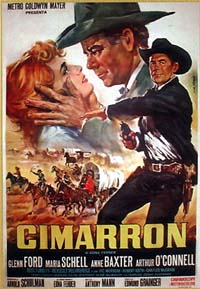
Cimarron

Directed by Anthony Mann
1960
The United States of America


It started, quite literally, with a bang.  An estimated 50,000 people listened for that fateful gunshot which signaled the start of the 1889 Oklahoma Land Rush.  The rules were simple: at 12:00 noon, two million acres of Oklahoma land became free for the taking.  All you had to do was be the first to stake a claim, and 160 acres of prime Oklahoma land was yours for the taking.  Of course, you had to be the first to get there.  So on that fateful morning, thousands of homesteaders lined up on the Oklahoma border, eager for a new life.  Never mind that the land used to belong to the Cherokee and Sioux, there were white families to think about.  Among these settlers were Yancey and Sabra Cravat.  Little did they know, but their lives would represent the great American struggle of Manifest Destiny in all of its glory and shame.  Ahead of them lay adventure and heartbreak, success and strife, glory and tragedy.  Theirs’ would be the story of the Old West.  Theirs’ would be the story of Cimarron.


There are two ways to interpret Cimarron.  The first is to simply take it at face value.  In doing so, you are presented with a Western of staggering scope and complexity.  Director Anthony Mann, who had previously revolutionized the Western genre with his work with James Stewart, went about making Cimarron one of the biggest films of his career.  In fact, Cimarron was the first of Mann’s three great cinematic epics (the other two being El Cid and The Fall of the Roman Empire).  Everything about this film was massive.  It featured such big name stars as Glenn Ford, Maria Schell, and Anne Baxter.  It sported a tremendous musical score written by two time Academy Award winning composer Franz Waxman.   Robert Surtees, the three time Academy Award winning cinematographer (most famous for his work on Ben Hur), manned the cameras.  Coming in at a whopping 147 minutes, it looked big, sounded big, and felt like one of the biggest Westerns ever made.

But there is a second way to view Cimarron: as a devastating allegory of American Westward expansion. The film followed the Cravat family as they strove to make their fortune in the untamed wilds of the American West.  Yancey is the all-American pioneer: handsome, friendly, popular with everyone he meets.  Always looking for the next opportunity.  His wife, Sabra, is an immigrant.  She is everything that Yancey is not: quiet, emotional, desperate to settle down.  But they still desperately love each other.  The relationship between Yancey and Sabra represents the duality of the American spirit, one that is restless yet cautious, full of bravado yet thirsty for a sense of security.


But the allegory goes deeper.  Sabra is an unabashed racist.  She is extremely vocal of her distrust of blacks and Indians.  Yancey, on the other hand, crusades for the rights of Indians and other minorities.  When an Indian couple tries to take part in the Oklahoma Land Rush and are subsequently lynched, Yancey kills the perpetrators.  So, in a sense, Yancey represents the idealistic side of American culture: the idea of the ethnic melting pot, that all men, no matter who they are or where they come from, are equal.  Meanwhile Sabra represents the honest truth. 

I could wax philosophical about all of the ways that Yancey and Sabra could be interpreted.  But really, the story is the most symbolic part of the film.  After greedily sucking up all of the Indians’ land via the Land Rush, the settlers force even more land from the Indians.  Yancey is desperate to take part in the colonization of the stolen Cherokee land...so much that he literally abandons his wife to pioneer it.  Yancey frequently takes long leaves of absence to satisfy his wanderlust: he goes to Alaska and kills a grizzly bear, he takes part in the Spanish-American war, he even travels a good part of the world.  He is gone for so long that Sabra has to raise their infant child almost to maturity alone.  If Yancey is the spirit of American idealism, then Cimarron bravely explores its sinister side: America’s willingness to abuse and abandon whatever gets in its way, be it the environment, the sovereignty of natives and foreign countries, and even its own citizens.  Yancey is both hero and villain.  But he does come back in the end.  Sabra, much to our surprise, welcomes him home.  They may be opposite sides of the American identity, but they can never be separated for very long.

Released in 1960, Cimarron was actually a remake of the 1931 film of the same name which had won three Academy Awards, including Best Picture.  The original had been a massive success and was infamous for two things.  The first was its depiction of the infamous Oklahoma Land Rush which utilized more than 5,000 extras, 28 cameramen, and an untold army of camera assistants and photographers.  Its second claim to fame is additionally the reason why almost nobody has heard of it or seen it since its release in the 1930s: its racist depiction of ethnic minorities.  Blacks, Jews, and Native Americans are all represented in this film, but in a poor fashion.  The blacks all talk like Stepin Fetchit and the less said about the depiction of Native Americans, the better.  Of course, people who have actually seen the original know that the film’s racist depictions of minorities are juxtaposed by Yancey Cravat’s progressive views.  But people don’t remember Yancey’s struggle to highlight the unfair results of treaties with the Cherokee Indians.  They just remember the smiling black shoeshine who dies in the arms of his massa in one of his first scenes.

But under the watchful eye of director Anthony Mann, the story, and characters, of Cimarron take a drastic change for the better.  Yancey and Sabra help run a progressive newspaper that fights for the rights of minorities and exposes the evils of local land barons and criminals.  The minorities, in particular the Indians, are portrayed with much more dignity.  Yes...this can be seen as an attempt to make the story more politically correct.  But in a way, it emboldens the characters and makes them more heroic.  Ever since the days of John Ford, the American Western has been one steeped in mythology and allegory...at least until the 70s and 80s with the birth of the Revisionist Western.  In a since, by making the film more politically correct, they are honoring the spirit of the American Western.

For whatever reason, Anthony Mann’s Cimarron has fallen into painful obscurity.  It is revived every now and then by appearing on television...but it has never been remembered as the great piece of filmmaking that it truly is.  Even back during the time of its release, it was largely over-looked.  This is a tremendous shame.  Cimarron is a part of the grand tradition of American Westerns.  Until the time when it finally gets its day in the sun, we shall just have to wait...just like Sabra did for ol’ Yancey...

Sunday, September 4, 2011

Update: No Review This Week + Storytime

Alas, my dear readers, I cannot do a review this week.  I'm still busy getting settled into my new life at New York University Tisch.

But I don't want to leave you all empty handed two weeks in a row.  So...I have a story to share.

This is a TRUE STORY.

I live in a suite right on the corner of Washington Square in New York City.  As such, I have a roommate.  This roommate is a young computer programmer from Southern China.  I won't mention his name because he hasn't given me permission to do so online.  Anyhow, for the last few days, I've been trying to establish some common ground with my new roommate.  However, due to the language barrier, this has been difficult.

But tonight I made a breakthrough. 

It turns out that he loves movies, too.  He discovered this blog when he was researching me after we were assigned the same room.  He remarked that he was astonished that I had written about Jiang Wen's film Devils on the Doorstep.  He was amazed because that film is banned in China. 

He asked me how I saw the film.  I answered that I had seen it on Netflix.  He had never heard of the site and wanted to know what it was.  I showed him the site, explained how it was basically a giant movie library.  He was astonished.  Many of the films on Netflix are still banned in China.

For those of you who don't know, China has INSANE restrictions on foreign films shown inside their borders.  Incredibly, only TWENTY foreign films are allowed to be shown in China each year.  Think about that for a second.  The average American probably sees twenty or so films a year at the movie theater.  Even then, that's only a fraction of a fraction of a fraction of the number of movies that come out in the US alone.  Not only are foreign films nearly impossible to get a hold of in China, many films are outright banned by the government.  These banned films include, I kid you not:

-A.I. - Artificial Intelligence
-Avatar
-Back to the Future
-Ben-Hur
-Brokeback Mountain
-The Dark Knight
-The Departed
-Memoirs of a Geisha
-Pirates of the Caribbean: At World's End
-And many, many other Chinese films that have fallen out of favor with the government

And yet, right before my roommate's eyes, I was showing him a site where he could watch all of these films.  Even more incredible to my roommate was that this was legal.  He asked me if you got in trouble for watching these films.  I told him the truth.  "No, it's perfectly legal."  My roommate was amazed.  He told me that in China if you wanted to watch something non-approved by the government, you had to download it.  And in China, with their massive agencies designed to keep a close eye on their citizens' internet activities, doing so could get oneself into serious trouble with the law.  So naturally he was suspicious and wary of a site with so many banned films. 

Then he asked me a strange question: "Don't they ban films in America?"  I paused for a second.  I wondered what I should say.  Then I decided, once again, on telling the truth.  "Not really.  The federal government can't officially ban a film in this country.  Some local governments can, but I can't think of any instances when a movie has been banned by federal law."

Upon hearing my answer, my roommate lowered his head, dropped his eyes to the ground, and said in a half whisper, "That's because America is a free country."

As I write this, my roommate is busy setting up his own Netflix account.  I have provided him with a list of great films that I thought that he might enjoy and may never get to see in China.  This was one of the first times in my life that I understood just how powerful and meaningful my country's freedoms are.  Folks, I'm proud to be an American.  I'm proud to live in a country where men and women have given their lives in order to protect my Freedom of Speech.  It might sound cheesy, but I really do.  And, of course, I recognize the brave men and women who have also given their lives to protect basic human rights in other countries.  In the Western world, it's so easy to take our freedoms for granted. 

So be thankful, folks.  Be thankful that we live in a part of the world where information is free for the taking.  For there are many, many people, just like my roommate, who live in places where it is not.

Editor-in-Chief
Nathanael Hood

Sunday, August 28, 2011

Update: No Review This Week

Well, folks...

Tomorrow I'm moving to New York City to attend film school at New York University!  Due to the flooding from Hurricane Irene, the next few days are going to be complete insanity.  Because of this, I won't be able to write a new review this week.

Hopefully, I'll be able to return next week with a brand new Forgotten Classic!

Stay safe and dry, everyone!

Editor-in-Chief
Nathanael Hood