Where Forgotten Films Dwell

Welcome to this site! It exists for one reason: to preserve the memory of films that have been forgotten about or under-appreciated throughout the ages. Take a seat, read an entry, leave a comment. You might discover your new favorite movie!

Monday, May 17, 2010

Note from the Editor: We're on Flattr!!

Hello readers!

Great news! This site is now a proud member of Flattr!

What is Flattr, you ask? Well, it's a new online based method for making mircopayments to sites that you like! Basically, it's like favoriting a video on youtube, except when you favorite it, the maker gets paid! I am extremely excited about this! To explain, please watch the following helpful video!


To become a member, go to their website at flattr.com.

This is a great way to support this site and make sure that it can keep operating. Plus, with more money I will be able to get more obscure and unheard of movies, which means more reviews!

Look for the flattr button on this site!

-Nathanael Hood

Friday, May 14, 2010

Note from the Editor: Brief Break

Hello readers,

I have some bad news. I am currently being treated for a medical disorder that has plagued me since childhood. As a result, I will be unable to write reviews for some time. I will return to writing on this blog on May 18.

Nathanael Hood

Saturday, May 8, 2010

Bab el Hadid (Cairo Station)

Directed by Youssef Chahine
1958
Egypt


After an original screening of Cairo Station in 1958, it is reported that a man spat in the face of its director, Youssef Chahine, saying, “You have given Egypt a bleak image.” A film about a degenerate who kills women as a result of fits of rage brought on by sexual frustration, it was unlike anything the country of Egypt had ever seen before. Until then, Egyptian cinema had been defined by feel good movies that presented mindless escapism for the masses. But here was a film that dared to explore the darker side of human nature and carnal desire. By today’s standards, it is very tame. There is no explicit sex and there is only one on-screen murder. But it was still provocative enough to enrage Egyptian society. The country’s critics condemned it as a blight on Egyptian cinema. The film was then banned for twenty years. It was only when it was shown in foreign film festivals two decades later that the world began to realize the film’s sheer genius. Now, the film that was originally hated and banned in its home country is recognized as one of its finest.

The film centers around a simple-minded newspaper-seller named Kenaoui (played by the director Chahine) who works at a Cairo train station. By all standards, he is a degenerate, a sexual deviant who obsesses over sex, but cannot get it. Indeed, when we first meet him we find him being asked for a telephone token by a pretty girl. A point of view shot informs us that he barely heard her. All he can do is stare longingly at her beautiful legs. But he does more than just ogle women on the platform. Back home in his beaten down shack out on the tracks, he cuts out scantily clad women from the newspapers that he is supposed to be selling. He creates a kind of disturbing museum exhibition of cut-out women on his walls which he hungrily stares at all day.


His desire is fueled by Hanuma, a beautiful woman that he wishes to marry. She makes her living illegally selling drinks to passengers on trains. In his shack, he draws drink baskets on the pictures of women so they will resemble her. In his mind, they are the perfect couple. But in reality, she is engaged to Abu Serib, a porter who is desperately trying to set up a union. Despite her engagement to Abu Serib, she takes great pleasure in leading Kenaoui on. Played by Hind Rostom, one of the great Egyptian sex symbols of the 1950s, she is a whirlwind of ravishing cruelty. Consider the scene by a giant fountain where Kenaoui confesses his love for her. He gives her his mother’s solid gold necklace, a priceless heirloom, as a wedding present. Her reaction is to flippantly say that it is fake. Unfazed, Kenaoui tells her of the life that they could share and how hard he would work to provide for her. With a sinister smile she listens until she cannot restrain herself anymore and rebukes him.


As he is teased by Hanuma, his behavior becomes more and more erratic. He begins to fantasize that they live together and attacks a cat that he believes is mocking him. Reports start to come in that different women have been brutally murdered and decapitated all over the city. These rumors seem like mere gossip, at least until Kenaoui beings to cut up the women on his walls. It is revealed that he is the killer who murders when his sexual frustration gets to a boiling point. In one of the film’s best scenes, he attacks a female worker at the station with a gigantic knife. The film utilizes dramatic and swift editing during the murder scene as the camera shifts back and forth between killer, victim, knife, and a barking dog that happened to be nearby. This kind of furious editing predated the infamous shower scene in Alfred Hitchcock’s Psycho by two years. To say that it influenced Hitchcock is nonsense, as he would have had no way of seeing it after it was banned in Egypt. But the similarities are unbelievably uncanny.

In fact, the similarities with Hitchcock are abundant. Take one scene where Kenaoui watches a crate with the body of his victim being carried by porters onto a train. Several times, the workers almost open it up to reveal the body. They struggle with it, commenting how unusually heavy it is. It is reminiscent of the famous scene in the cellar from Notorious (1946) where Ingrid Bergman knocks over a bottle containing uranium. Both scenes play with the audience, taunting them with dangers that get closer and closer until we cannot take it anymore.

Another similarity is the character of Kenaoui. He can be interpreted as a mixture between Norman Bates (Psycho) and John Ferguson (Vertigo). He is a madman, like Bates, who is driven to kill by his own neurosis. And much like Ferguson, he is driven forward by an obsession with a beautiful woman. Just as Ferguson tried to possess a dead woman by making another dress up just like her, hair color and all, Kenaoui tries to possess Hanuma. He becomes so obsessed by her that his rejection leads him to lose his mind.


Cairo Station is an amazingly complex film, but it doesn’t feel like one. It isn’t bogged down by its own plot as many intricate thrillers are. Instead, it moves with a lively energy that gives the film a life of its own. Notice how in the opening scenes the editing cuts only last long enough for the characters to deliver their lines before the camera is whisked away somewhere else. It is as if the film itself is mimicking the hustle and bustle of the train station. The plot takes time to develop each character, but we never feel like we are watching needless exposition. This is a tightly crafted, expertly executed film.

Great films need great directors. Cairo Station was blessed with one of Egypt’s greatest directors, Chahine, at its helm. During his career that spanned over four decades, he established himself as one of Egypt’s most active, controversial, and talented directors. While he constantly evolved as a director, one thing remained the same during his career: his love for his country. Born a Christian, Chahine would distance himself from organized religion later in his life. When he was asked if he would identify his religious beliefs, he answered: Egyptian. It was with this mindset that Chahine created Cairo Station. It examines the difficulties and problems that plague Egypt’s society, such as rampant sexual repression. But at the end, the forces of good manage to stop Kenaoui before he can kill his beloved. It is a desperate cry that Egypt, flawed as it might be, can overcome its own problems and set a course for its own better future. How appropriate for a man who did so much to influence the course of cinematic history.

Part One of Cairo Station


Sources:
http://cinephilefix.wordpress.com/2010/02/20/cairo-station-bab-el-hadid-1958/
http://en.wikipedia.org/wiki/Youssef_Chahine
http://www.bbc.co.uk/films/2002/06/10/cairo_station_1958_review.shtml

Wednesday, May 5, 2010

Keoma

Directed by Enzo G. Castellari
1976
Italy


The Old West is a land entrenched with mythology. Stories of legendary gunslingers, fierce Indian braves, and ruthless cattle barons flood across the mind like ever present tumbleweeds making their lonely journey across the scorched desert. But the West wasn’t always interpreted as such a mysterious place. In America, the birth land of the Western, they usually were somewhat based in reality. There were, of course, understandable embellishments, but the Westerns of Ford, Hawks, and even Mann took place in world that could be perceived as our own. The Spaghetti Western changed all of this. Named “Spaghetti Westerns” because they were mostly produced and directed by Italians, they represented a niche genre of about 600+ films made from the mid-sixties to the late-seventies. Usually shot in cheap locales reminiscent of the American Southwest, such as the Andalusia region of Spain, they were low budget masterpieces of cinematic thrift and originality.

They were usually directed by Italians, populated by Spanish and Italian extras, and sometimes graced by the presence of a Hollywood star. Since the cast would speak several different languages on set, dialogue was sparse. The little talking that was provided would be dubbed into different languages in post-production. Thanks to the abundance of cheap Spanish and southern Italian extras, they frequently took place on the US/Mexico border. What they may have lacked in substance, they made up in style. Slow motion gun fights, creative cinematography, evocative music, and brooding protagonists were just some of the stylistic innovations that propelled Spaghetti Westerns into pulp greatness.

But more importantly, Spaghetti Westerns reinvented the genre with new themes and character archetypes. Suddenly, cowboys became objects of myth. In a heartbeat they would be able to kill six men with six bullets. Morality became distorted even more than in the James Stewart and Anthony Mann collaborations. The “heroes” became capable of being just as ruthless as the villains, since they were usually motivated by revenge. The most famous Spaghetti Westerns are the “Dollars Trilogy,” directed by Sergio Leone, scored by Ennio Morricone, and starring Clint Eastwood as the “Man with No Name.” They are seen as some of the first Spaghetti Westerns ever made.

If the “Dollars Trilogy” established the genre, then a small film entitled Keoma ended it. It wasn’t because it was a bad film. Instead, it acts as a kind of eulogy to a dying genre. It both celebrates the genre’s history and mourns its passing. In an incredible article on the film, author Danel Griffin writes:

“This knowledge of its own fate is ultimately what makes Keoma such a sad experience: Every tiniest detail here understands that it symbolizes a finished era in European cinema. The film’s characters are certainly lost in their personal sadness; its themes deal with impending death; its camera work, which often rests thoughtfully on a character’s conflicted face as its gloomy music plays, is slow and despairing.”

Truly, this is a film that pulls no punches. It knows what it is and what it represents.

Our hero, if we can call him such, is a half breed Indian named Keoma. We meet him returning from the Civil War to find that his town has been overcome by a devastating plague. In the chaos, the town has fallen under the dictatorial rule of a group of thugs controlled by an ex-Confederate raider named Caldwell. Among his posse are Keoma’s three half-brothers who hate him for being a half-breed. Flashbacks to his past reveal that even as children they hated him. Now, they have grown up and have guns. They intend to keep Keoma out. But Keoma has other plans.


While most of the people in the town hate him, he still has a few allies. First is George, his former slave and friend who took advantage of his new-found freedom by crawling into the bottom of a bottle. He also meets up with his father, who has become mercilessly wizen by old age. Together, they embark to smuggle food and medicine into the town. All goes well at first, but as fate would have it they are eventually discovered. The chances of a peaceful resolution have been destroyed. These men know they must destroy each other or lose control of the town. Everything leads to one last showdown where brother must fight brother and family ties must be severed with hot lead.

The movie is both a visceral experience and a metaphorical triumph. It evokes nothing less than the death of its own genre. The dying town represents the institution of the Spaghetti Western, which at the time of Keoma’s production was already in its death knells. Keoma’s desperation to keep the town alive can be interpreted as director Enzo G. Castellari’s attempts to preserve the genre. Castellari, an Italian director who made his livelihood on Spaghetti Westerns, must have known that his days were numbered, so he put everything that he had into Keoma. Nicknamed the “European Sam Peckinpah,” Castellari was a genius at shooting scenes of violence, particularly in the form of gunfights. His flair is evident in Keoma as the hero shoots his way through the villains who have taken over the town. Few directors have been able to choreograph violence. Plenty have been able to use fanciful editing to make violence seem orchestrated, but to truly make violence an artistic, and not just visceral, experience, it requires the likes of Sam Peckinpah, John Woo, and Enzo G. Castellari. Each time a body is hit and crumples to the ground, Castellari uses his beloved slow motion. He dwells on each death like a god pulling the strings of his subjects from high atop Mount Olympus. We are reminded that these are people who are being killed, and not just evil villains.

The themes of life and death are central to Keoma. One of the most important scenes in the movie is when Keoma is captured by his brothers and “crucified” onto a wagon wheel so he can be displayed before the entire town. Yes, in a sense Keoma is a Christ-like figure. We sense this in the last shootout where Keoma guns down his three brothers in an old barn. The entire time that the brothers are killing each other, a pregnant woman screams from labor pains on the barn floor. This juxtaposition of life and death leads the audience to realize that for the town to survive, for the child to have a future, Keoma must sacrifice his own brethren. His own flesh and blood is the price for the town’s future. After the smoke clears, the three brothers and the new mother lie dead. All that can be heard are the muffled cries of the newborn baby. A woman beseeches Keoma to stay and take care of the child so it doesn’t die. Keoma jumps on his horse and yells, “He can’t die. And you know why? Because he’s free. And man who’s free never dies.” I guess the same thing can be said of the Spaghetti Western. By choosing to seal its own fate in Keoma, Castellari made sure that the genre that he loves would never suffer the pitiful fate of so many others.


Go here for the aforementioned article on this film:
http://uashome.alaska.edu/~dfgriffin/website/keoma.html

Sources:
http://en.wikipedia.org/wiki/Spaghetti_Western

Monday, April 26, 2010

Тіні забутих предків (Shadows of Forgotten Ancestors)

Directed by Sergei Parajanov
1964
Ukrainian Soviet Socialist Republic


Robert J. Flaherty, the director of the first commercially successful feature length documentary film, Nanook of the North (1922), once said, “Sometimes you have to lie. One often has to distort a thing to catch its true spirit.” This controversial statement speaks to the heart of his legendary film Nanook of the North, which follows a family of Inuit living in the Canadian arctic. While it is considered to be a milestone in documentary filmmaking, its authenticity has been challenged over the fact that Flaherty staged many of its sequences, such as making the title character hunt with a spear when he had hunted with a gun for years. But those who would defend the film point out that while Nanook was using with the wrong weapon, he was still captured on film hunting real wild animals. While the details were skewed, the most important aspect of the hunting ritual, the interaction between hunter and prey, remained intact.

So this raises a simple question: can filmmakers lie in order to tell the truth? This question can be taken a step further by asking if fiction can be used to capture reality. This conflict between reality and fantasy is at the heart of one of the true triumphs of Soviet filmmaking, Shadows of Forgotten Ancestors. The first film by the notorious Sergei Parajanov, who spent his entire career at odds with the Soviet government over the content of his work, it is a loving reconstruction and depiction of Ukrainian Hutsul culture. Now, let me establish one thing at the start: Shadows of Forgotten Ancestors is not a documentary, nor does it intend to be an ethnographic reconstruction. However, just like the title suggests, Shadows of Forgotten Ancestors is a kind of shadow theater of a culture long neglected. Its story is an outgrowth of Hutsul tradition and culture. Through the use of fiction and fantasy, Parajanov creates one of the most authentic realizations of a unique culture in the history of cinema.

The film takes place in the heart of the Carpathian Mountains of Ukraine. Inhabiting these foggy rocks is a small village. In it, we meet two small children, Ivan and Marichka. Though they are young, they fall in love. But as fate would have it, their relationship is forbidden, as Marichka is the daughter of the man who killed Ivan’s father. But as they grow older, there love increases. They decide to marry despite their families’ conflict. But one day when Ivan is out earning money for a household, Marichka accidentally drowns in a river. Ivan is understandably heartbroken. Years later, though, he meets another woman, Palagna, and marries her. Sadly, their relationship becomes strained as it becomes apparent that Ivan still loves Marichka. Palagna eventually asks a local sorcerer to make him fall in love with her and give her a child. But Ivan discovers the relationship between Marichka and the sorcerer and tries to kill him with an axe one night. The sorcerer retaliates, supposedly killing him. We then follow his soul as it travels into the woods to meet with the spirit of Marichka. Finally, the two lovers are together.

If it sounds like I am rushing through the story, it is because I am. But that is because the film itself seems to consider the story as secondary. True, it needs the plot to push the story forward. But where the true majesty of this film lies is in its attention to everyday Hutsul life and culture. For example, Parajanov seems to spend more time detailing the Hutsul marriage ceremony than he does exploring Ivan and Palagna’s courtship. Like a surgeon, he dissects the various wedding traditions and offers them up to the audience. We are confronted by every little detail, from the ceremonial outfits to the processions and to the act of uniting the two in holy matrimony. The scene where Ivan and Palagna are blindfolded and yoked together in front of the altar seems more important than the words being said or their religious significance. Parajanov must have assumed that his audience would have been familiar with Christian religious ritual, so he obsesses over the ceremony’s Hutsul flavor.


It is this flavor that dominates the film. It isn’t enough to show Ivan working in order to save money for Marichka, we must be shown how the work is done. Why have a funeral or a wedding if we cannot watch the festival that takes place afterwards? And at that festival, why just show people dancing? Why don’t we pay close attention to how the villagers dance? It is the how, not necessarily the why that dominates the film. By focusing on these details, this movie’s simple, if not contrived, plot takes on distinctive Hutsul characteristics. It becomes a living witness to the Hutsul people and their culture. It is for this reason that Shadows of Forgotten Ancestors is able to tell the truth about a society. Through fiction, it is able to depict the authentic heart of an entire society.


But to assume that Shadows of Forgotten Ancestors is a slow, boring film is entirely inaccurate. In fact, it gallops with an energy that few filmmakers have been able to match. Parajanov’s camera is as giddy as a little child, swinging and swaying around his characters and their village. In times of rapture, it flies with the energy of a ribbon around a maypole. And when there is tragedy, it suddenly becomes more stoic and contemplative. Also of note is Parajanov’s incredible use of color. Different shades and hues dominate the screen during times of turmoil and conflict. After Marichka’s death, Ivan spends time mourning. During this time the film is in black and white. At other times, the frame composition contains muted colors only to be suddenly splashed by reds and yellows. In one memorable scene, Ivan hallucinates a stampede of red horses which seem to melt into a stream of blood. But these do not conflict with the film’s authenticity. They represent the polarizing emotions and feelings experienced by those within Hutsul society.

Daring, haunting, foreboding, and beautiful, Shadows of Forgotten Ancestors creates a new world for the cinema to inhabit. It is a Hutsul world, and it is stunning. But maybe it was a little too stunning. Because of its style and content, it was at odds with the social realism style that the Soviet government supported. They demanded that the film be changed. Parajanov refused and was eventually blacklisted from Soviet cinema. Because of the Soviet ban on his work, the man who could have easily gone down in history as one of the cinema’s greatest auteurs could only make three more films after Shadows of Forgotten Ancestors. But thankfully his few works do survive as a testament to his talent and genius. Maybe we can learn from them. After all, not many films have been able to redefine and reinvent the way that we look at society, culture, and our fellow man. It is our duty to preserve them, just as Parajanov immortalized the Hutsul in this forgotten treasure of a film.

Sergei Parajanov

Sources:
http://en.wikipedia.org/wiki/Shadows_of_Forgotten_Ancestors

Friday, April 23, 2010

The Man from Laramie

Directed by Anthony Mann
1955
The United States of America


Barbara Waggoman: Did you have any trouble getting here?
Will Lockhart: No, we came from Laramie.
Barbara Waggoman: Oh, is that your home?
Will Lockhart: No, ma'am. No, I can't rightly say anyplace is my home.
Barbara Waggoman: Oh, but everybody should have a place to remember and feel they belong to.
Will Lockhart: Well, I-I always feel like I belong... where I am.

In the history of the Western, there have been times when an actor and a director would break and subsequently rewrite the rules of the genre. John Ford and John Wayne proved that Westerns could be more than pulp pictures with their work on Stagecoach (1939) and in fact reach the levels of high art. Sergio Leone and Clint Eastwood reinvigorated the genre with the Dollars Trilogy with the creation of the Spaghetti Western. But there is one more actor/director duo that forever changed the face of the Western. They are Anthony Mann and James Stewart. Even though they only worked together on five Westerns, their impact shook the foundations of the Hollywood establishment.

Both had worked in Tinsel Town and made names for themselves long before collaborating. Everybody knows about James Stewart, the dependable everyman whose “aw shucks” attitude helped him conquer any odds that society threw at him. He was most especially known for his successful runs with Frank Capra and Alfred Hitchcock, creating such legendary films as You Can't Take it With You (1938), It’s a Wonderful Life (1946), Rope (1948), and Rear Window (1954). He had even starred in Westerns before. Probably his most memorable early Western was his first, Destry Rides Again (1939) where he played “No Gun” Destry, a pacifist lawman who brings order to a crime-ridden town.

But as time went by, his roles became more and more dark. His can-do attitude was replaced by cynicism. Just take his work with Hitchcock. He went from being a voyeuristic, but basically good hearted character in Rear Window to becoming a paranoid, obsessive police investigator ten years later in Vertigo (1958). Maybe it was destiny that in the 1950s he teamed up with Anthony Mann.

Mann, who had cut his teeth apprenticing for Preston Sturges, had established himself as a director of great film noir, such as the magnificent Desperate (1947), He Walked by Night (1948), and Raw Deal (1948). But his best work lay in directing Westerns. Instead of focusing on clashes between good and evil, or cowboys wearing white hats and cattle barons wearing black hats, his work was centered on anguished heroes trying to escape their pasts or personal demons. One of his greatest films, The Furies (1950) with Barbara Stanwyck, plays more like a classical Greek tragedy than a Western.

And so when Stewart and Mann joined forces, their five Westerns redefined the way that Westerns worked. Suddenly, the Old West was a hostile, amoral place. Heroes were often flawed and morally ambiguous, driven to extreme (and frequently violent) ends in order to avenge wrongs done to them. In their first collaboration, Winchester ’73 (1950), Stewart pursued a group of outlaws who had stolen a Winchester rifle that he had won in a contest. His almost suicidal obsession for revenge was only matched by the rifle itself, which seems to be cursed, as its every holder would meet an untimely end.

So it should come as no surprise that their last film, The Man from Laramie (1955), would be one of their best, and one of their darkest. Here, we find Stewart as Will Lockhart, the leader of a wagon train bringing supplies into the small town of Coronado. The town is owned and ruled by the Waggomans, a powerful ranching family. When Lockhart starts harvesting salt in a field that he was told was free, a posse led by Dave Waggoman shows up, attacks him, burns his wagons, and shoots his mules. It is likely that Dave would have killed Lockhart if not for the appearance of ranch foreman Vic, who tells him to stop. Vic, although not related by blood to the Waggomans, considers the family patriarch, Alec Waggoman, to be a father figure. He is constantly at odds with Dave who is an arrogant, violent man who secretly sells rifles to the local Apache Indians. Though Vic is clearly the right choice as successor to Alec, who is quickly ailing and almost blind, he is passed up in favor for the incompetent Dave.


The last thing that the Waggomans need is the meddling figure of Lockhart who demands restitution for his destroyed goods. When Alec pays him and asks him to work for him, Lockhart refuses. While he doesn’t want to be with the Waggomans, he intends to stay in Coronado. He intends to find out who has been selling the rifles to the Apaches, as his brother had been killed in one of their attacks. It doesn’t help that on the way to Coronado he encountered the charcoaled remains of a US Cavalry patrol that had been massacred by the Apache. Like Humphrey Bogart seeking his partner’s murderer in The Maltese Falcon (1941), Lockhart will not rest until he finds his the man who sold the rifles to his brother’s killers.

In many ways, The Man from Lamarie plays like a film noir. In fact, the title is one of the main indicators of this theme. Notice that the title doesn’t refer to the plot or the actions in the film. It is concerned with Lockhart’s past. By naming Lockhart as the man from Lamarie, the film establishes him as a man dominated by his past and his obsession to right past wrongs. Like the classic film noir “heroes” of old, the only way he can look to the future is by living through the past.

By the end of the film, two Waggomans will lie dead, one killed by Lockhart and one killed by his “brother.” Lockhart will have his revenge, but at what cost? Over the course of the film, he will transform into a wild eyed madman. There is a love interest in the form of female member of the Waggoman clan, but it is played out as almost an afterthought. What matters is Lockhart and how he interacts with the male Waggomans. Each betrayal and twist feels like a punch to the gut. By the end of the film Lockhart will seem as bloodied and twisted as the very men that he seeks vengeance against.


By introducing elements of film noir into the Western, Mann and Stewart would make sure that the genre would never be the same. Mann’s piercing direction and Stewart’s uneasy, morally ambiguous character in The Man from Lamarie, just like their other four collaborations, would leave a lasting influence in the universe of cinema. Just look at how it affected the king of the Western, John Ford. Before Mann and Stewart’s Westerns, Ford’s morals were black and white. In She Wore a Yellow Ribbon (1949), John Wayne plays an aging US Cavalry captain who acts as a belligerent father figure to his men. As the hero, he fights against evil Indians who want to cause mayhem and destruction. Then, one year after the release of The Man from Lamarie, Ford released The Searchers, where Wanye plays an old racist seeking to rescue his niece after she is captured by Comanche Indians. However, in his mind, the only way to save her after being “polluted” by the Comanche for so long is to kill her. The father figure had been replaced with a man more than willing to kill his own flesh and blood.

The influence of Anthony Mann and James Stewart on the Western genre cannot be understated. Because of them, the genre was able to advance past its infantile stage of good guys against bad guys and explore themes that it had never dreamed of before. Characters became more complex: heroes became corruptible and villains became sympathetic. While it would take the likes of Sam Peckinpah and Sergio Leone to increase the visceral violence that was seen on the screen, it was Mann and Stewart that made the Western enter into its own conflicted adolescence. The Western was no longer a child.


Anthony Mann

Sources:
http://en.wikipedia.org/wiki/Anthony_Mann
http://en.wikipedia.org/wiki/The_Man_From_Laramie

Saturday, April 17, 2010

De Man Die Zijn Haar Kort Liet Knippen (The Man Who Had His Hair Cut Short)

Directed by André Delvaux
1966
Belgium


How does one define obsession? Is it an overactive, consuming desire for something? Does it manifest itself in maniac behavior subjected to uncontrolled whims? Or is it something more diabolical? Does it seep into one’s mind in order to slowly grow over time only to subtlety influence the actions of weaker men? Perhaps. Perhaps not. It’s difficult to say, as the force of obsession has influenced mankind for millennia. But that hasn’t stopped the cinema from trying to define it.

Probably the most familiar form of obsession that we are familiar with is romantic obsession, that unstoppable urge to be with someone. We have seen it thousands of times. A boy/girl wants another boy/girl, hi-jinks and setbacks ensure, laugh, cry, rinse, dry, repeat. Sometimes if we are lucky we may get something special, like a vengeful murder or a tearful confession at the end. But for most of us, the idea of obsession has played itself out so many times that its stages are the epitome of cliché. But then there are other films that dare to explore the root of obsession itself.

Three films immediately come to mind. There is Alfred Hitchcock’s Vertigo (1958) where James Stewart’s character becomes obsessed with a dead woman and tries to turn his lover into her by making her change her appearance. The other two are companion pieces, one having inspired the other. The first is Ingmar Bergman’s Persona (1966) and the second is Robert Altman’s 3 Women (1977). Both have to do with strong willed women having their identities (and possibly more) consumed by weaker women who desire to be like them. They are slow-moving, calculated films that dare to ask why we become obsessed with others and what that obsession can lead to. But I would like to include one more film among these as a penetrating study on the nature of obsession.

That film is André Delvaux’s The Man Who Had His Hair Cut Short. A character study in the guise of a thriller, The Man Who Had His Hair Cut Short is a fascinating study of human behavior and motivations. The film’s central character is Govert Miereveld, a schoolteacher who has become entranced by one of his students named Fran. Over the course of the film we will watch Govert’s obsession lead him across the full specter of human emotions, and quite possibly to the brink of insanity.

When we first meet Govert, he is preparing to go to his school’s graduation ceremony. This will be the last chance that he has to see Fran. During the entire commute to school, Govert seems to be in a trance. He spends every second thinking about Fran and how much she loves her. Internal narration is provided by a voice over which fills us in to every thought and memory. But before he goes to school, he stops for a haircut.


The entire haircut scene is surreal. Govert, who is already in the advanced stages of balding, loves to get his hair cut. Just like his obsession with Fran, his love of haircuts is irrational. He doesn’t need them, but he still compulsively gets them. Here we see the one of the first glimpses into Govert’s psyche: he is ruled by obsessions that can provide him with no discernable benefit. Could it be that the obsessions provide a measure of comfort in a world that he is barely defined in? After all, we get the sense that he has a very ordinary life. He has a wife and child, but we see them so rarely that they might as well not be there at all. At school, he is just another teacher among the masses of educators. Could his obsessions provide him with a source of identity? Maybe, but perhaps I am getting off topic.

Anyway, he has a matter-of-fact conversation with the barber concerning his love of haircuts as his hair is trimmed, sideburns sculpted, and head massaged. Here, we see one of the most obvious uses of a technique that the director will use in order to emphasize internal turmoil or content: an extreme close-up. We don’t see that barber’s face. In fact, we can barely see his hands as they go about their skilled work. The shot is completely concerned with Govert. Time and time again, similar shots will fill the screen with faces. We sense an almost Bergmanesque obsession with the face. Perhaps it is because a shot that is consumed by a face represents a character consumed by internal passions or desires.


After the haircut, we see him attend the graduation ceremony. He takes his seats among the other teachers and stares uncontrollably at Fran, hoping that she will look at him. Afterward, he sneaks backstage when the graduating girls, including Fran, are performing a farewell show for the school. As Fran takes the center stage, Govert cannot help but be consumed by his passion for Fran. But nothing comes from it. The day ends and Fran leaves. The pain of separation is too much for Govert, so he quits his job as a teacher and becomes a member of the justice department. Staying at the school would have reminded him of Fran too much.


From here, the story becomes disjointed and allegorical. While the first half was content to dwell in realism, the second part leaves us confused as to what is real and what isn’t. It all begins with Govert being invited by a coroner to come along on a post mortem examination of a potential murder victim who has recently been dug up from his grave. The event is very disturbing for Govert. Different things that he encounters during the examination have unconscious links to different objects that he was in contact with during his obsession with Fran. A cranial saw is reminiscent of the scalp massager that was used on him during his haircut before the graduation ceremony. The cadaver is missing fingers, just like the gift of a hand sculpture given to a retiring teacher at the ceremony. The cadaver even reminds him of a mask on a covered table in the school storage room. In a brilliant essay on the film on the website filmref.com, we read, “Despite the imbalancing fragmentation of the narrative, Delvaux's subtle assimilation of recursive patterns that weave throughout the seemingly disconnected episodes in [Govert]'s life reflect an intrinsic cohesiveness within the singularity of [Govert]'s perspective and provide insight into the (a)logical structure of his seemingly fractured and aimless life.” Despite the changes made in his life, he cannot escape his connection to Fran.


Things get even worse when they stop at a hotel on their way home. In a bizarre twist of fate, he runs into none other than Fran herself at the hotel. Now a successful celebrity, she remembers Govert and accepts his invitation to talk to her. In a strangely detached scene, Govert confesses his love to her and she reveals that she has loved him since her school days.


Of course, whether or not this actually happened is up to the viewer to decide. I won’t give the ending away, but it calls the entire hotel scene into question along with the audience wondering at the state of Govert’s sanity. Has his obsession consumed him? Or maybe, just maybe, was the fulfillment of his obsession so alien to him that he could not handle it? Is it possible that his whole persona relied on his desires going unrequited? It is up to the audience to decide.

The nature of obsession is a tricky thing. But The Man Who Had His Hair Cut Short makes a valiant attempt to decode it. By penetrating the inner world of its main character, we come to understand him more intimately than anybody else. We learn his motivations, his wants, and his reactions to forces outside of his control. Do they make sense? Are they supposed to make sense? Are we even supposed to know? Each viewer needs to answer these questions themselves. I just hope that they don’t become consumed by them.

Sources:
http://www.imdb.com/title/tt0129222/plotsummary
http://www.filmref.com/notes/archives/2006/03/the_man_who_had_his_hair_cut_s.html

Friday, April 16, 2010

گاو (The Cow)

Directed by Dariush Mehrjui
1969
Iran


What defines a man? Or, better yet, does a man define himself, or let others define him? If a man walks the streets and fights criminals, he is a vigilante. Give him a gun and a badge and he is a cop. He is a cop because he fits society’s idea of what a cop should be. Take those things away from him, and he goes back to being just a man. But what if that man depended on society to identify his place in the world? What if he was so used to being a cop that to deny him of a badge and a gun causes him to lose his grasp on who he is? These connections between objects, their purpose, their owners, and society at large have long been a subject of debate. One such arena for discussion is the world of cinema. Few films have examined this existential dilemma better than Dariush Mehrjui’s film The Cow. It centers on a man named Masht Hassan who has the only cow in his entire village. His identity and social status are defined by his ownership of the cow. So the film asks the question of what would happen if one day that source of identity was taken away.

We are immediately informed of the importance of the relationship between Hassan and his cow during the opening credits where we see the two as white silhouettes on a black background. This curious reverse negative creates an eerie atmosphere of that ejects the audience from any semblance of normalcy. Clearly, their relationship is more than just that of an owner and a piece of property.

We soon see Hassan taking his cow to a lake to wash it. We discover that he truly loves his cow and treats it like a small child, baby-talking it and playing with the soap suds. We are led to believe that the cow fills a hole left in Hassan’s heart. Although he is married, he has no sons. He speaks harshly to his wife, only calling her “woman” when he orders her to do something. Does he blame her for not having a child? The movie never addresses this. But there is a definite tension between the couple. And so we see him coddling his cow. At the end of the bath, he even towels her off with his own coat.


It is clear that Hassan is highly respected in his village. When he enters the square, the whole population warmly greets him, some leaning out of windows to welcome him. Hassan feeds off the attention, but he is still concerned with the cow’s safety. She is pregnant and will soon give birth. The thought of owning the only two cows in the village must fill him with an unbridled anticipation. Simply put, his livestock give him prestige. And so right at the start we see that the cow serves two very important roles in Hassan’s identity: it gives him a respected place in society and indulges his paternal instincts.

But one day when Hassan leaves town, something horrible happens. Hassan’s wife starts screaming in the town square. When the villagers come to calm them down, she tells them that Hassan’s cow is dead. They go to investigate. In its small barn, it lays on the ground in a small pool of blood. They are unable to figure out what killed it. Just that morning it had been healthy with a vigorous appetite. There are local bandits in the area that steal from the villagers at night, but why would they strike during the day? And more importantly, why would they kill the only cow instead of taking it? And so, we find the death of the cow as a kind of active MacGuffin; instead of an object that spurs the action forward, it is an action that pushes the plot forward. It doesn’t matter how or why it occurred. The mere fact that it happened at all is enough for the people involved to react.

Panicking, the villagers decide the bury the corpse and lie to Hassan, telling him that it ran away and one of their number is out looking for it. But of course, things do not go over as smoothly when he returns to the village. To put it simply, he has a complete and total mental breakdown when he learns that his cow is missing. Even the combined sympathetic goodwill of the entire village isn’t enough to console him. He starts to act erratically, sitting on the edge of town and looking into the distance with a blank look on his face.

But one day, nobody can find Hassan. They look everywhere for him until they find him in his dead cow’s stall. He is sitting at the back of the stall, facing away from the entrance. He is making strange noises, almost like those of a cow. When they hear this, the village leaders try to tell him that they have found the cow. They yell things like, “She’s fatter than ever,” and, “Thank God, she’s fine. Healthy and strong.” But when he finally turns around, he has a mouth full of hay. He stares at them, chews, and then turns his head and starts to eat more hay. They go in and try to talk to him. But the only thing he will say is, “I am not Hassan. I am his cow.”

Stunned by this turn of events, they try reason with him. But no matter what they tell him, all he will reply is that he is Hassan’s cow. Finally, in a last ditch effort, they try telling him the truth. One of the elders says, “Listen to what I tell you, yesterday your wife came to us in panic and said your cow was dead. We threw your cow in the old well.” When Hassan hears this, he starts to freak out. He yells that thieves are trying to steal him. He yells for Hassan, believing that he is watching out for him on the roof.

The film ends with the villagers tying him up to take him to a hospital. He resists and screams like an animal. His transformation is complete as he wails like a calf as they tie him up with rope. Eventually, the pull him through the rain while whipping him, calling him an animal, and telling him to move. With his beloved cow gone, he has no place in society and no means of self-identification. Maybe it was out of mercy that they abandon him when he breaks away and falls down a hill into the mud. Having become an animal, the only mercy that he can be afforded is to be allowed to die like one.


Not only is Dariush Mehrjui’s The Cow a great film, it is one of the most important one’s in Iranian history. It was made during the Iranian Revolution, obviously a time of great political turmoil in Iran. The only reason why it was even distributed was because Ayatollah Khomeini was reported to have liked it, thereby allowing it to be shown in theaters. But even then, it had to be smuggled out of the country in order for it to be shown at the 1971 Venice Film Festival. But from that moment on, the face of Iranian cinema would be forever changed. Many believe that it sparked the Iranian New Wave. But what we do know is that it inspired such legendary directors as Abbas Kiarostami. Mehrjui’s use of realism and symbolism would become defining characteristics of Iranian cinema. And all of these influences can be seen in The Cow. It’s amazing how such a simple story can spark such a great cultural uprising. Like the death of Hassan’s cow, the release of The Cow would create a personal redefinition of its viewer’s sensibilities. Thankfully, instead of driving them insane, it made them realize that Iran had the potential to become one of world cinema’s most powerful voices.

Sources:
http://www.imdb.com/title/tt0064356/
http://www.chinadaily.com.cn/citylife/2007-02/16/content_811002.htm
http://en.wikipedia.org/wiki/The_Cow_%28film%29

Saturday, April 10, 2010

Targets

Directed by Peter Bogdanovich
1968
United States of America


TO WHOM IT MAY CONCERN:
It is now 11.40 am. My wife is still asleep but when she wakes up, I am going to kill her. Then I am going to kill my mother.

I know they will get me, but there will be more killing before I die.


In a house in Los Angeles, a relic from another time reclines into a chair and thinks about his past. He goes by the name of Byron Orlok, which was a name that at one point meant something. He used to be one of the biggest movie stars in Hollywood. Horror was his specialty, becoming the go-to man for studios who wanted to make sure their latest creep fest made money. But now, almost nobody remembers him. He looks at his young friend Sammy Michaels, a young up-and-coming writer/director, and says, “Oh, Sammy, what's the use? Mr. Boogey Man, King of Blood they used to call me. Marx Brothers make you laugh, Garbo makes you weep, Orlok makes you scream.” His young friend tries to cheer him up. But it is no use, Orlok has officially announced his retirement and has finally come to terms with the fact that the world will forget about him.

In another part of town a young man named Bobby Thompson walks into a gun store. He buys several cartridges of ammunition. He is no stranger to the shop. He has gone there several times to get hunting supplies for his excursions with his father. But something seems different about him this time. The salesman looks at him and asks, “What’re you hunting this time?” Bobby eerily replies, “Gonna shoot some pigs.” He leaves the shop and goes to his car which is filled with rifles, pistols, and ammunition. Within a few hours Bobby will kill his mother and wife before going on a shooting spree from the top of an oil refinery. As the bodies pile up, the only clue about his whereabouts is a note that reads that he knows he will be captured. But before he is, many more people will die.


Both of these men, Byron Orlok and Bobby Thompson, represent two different eras of fear. Orlok represents a more innocent time when all the public had to fear were scary movies about zombies and ghosts. Bobby represents the new public awareness brought on in the Sixties, the decade that America lost its innocence, where the brutal realities of internal strife and a hopeless war abroad were brought home. It’s clear that they cannot coexist. There must be a reckoning…

Such is the story behind Peter Bogdanovich’s premier film Targets. While it may play like another dime store B-movie, it is actually a penetrating look into the heart of American society and the forces that rule and dominate its psyche. A devout film lover, Bogdanovich made this film when his mentor Roger Corman told him that he could make any film that he wanted as long as it stayed under budget. To Bogdanovich’s great luck, not only was he given creative control, he was given access to one of Hollywood’s biggest stars, Boris Karloff (most famous for his role as the original Frankenstein's Monster in James Whale's Frankenstein), because he owed Corman two days of work. Instead of making a cheap knock-off thriller, Bogdanovich used his scarce resources to create one of the best films of the Sixties that nobody remembers.

Karloff of course plays Orlok (a name taken from the vampire Count Orlok in Nosferatu) to perfection, perhaps because he was playing himself. Indeed, that is probably what Bogdanovich had in mind. Karloff and Orlok had many similarities: they were both legends past their prime, they were horror movie stars, and they were both tired, old friendly men. Unlike his rival Bela Lugosi who spent his last few years wasting away under the influence of addiction, Karloff lived a much happier life. Despite his onscreen persona, he was a friendly man who frequently gave to children’s charities, even dressing up as Santa Claus every Christmas to hand out presents to physically disabled kids in a hospital in Baltimore. But despite his kindness, by the end of the Sixties he was still a bygone fossil. In fact, Targets would be the last major American film that Karloff would star in. And his age showed, too. By the time shooting took place, Karloff only had half of one lung left and had to sit in a wheelchair between takes wearing an oxygen mask. But the fact remains that throughout his (and Orlok’s) career, he played villains and monsters that played fair. They killed people, sure, but they never broke the rules.


Contrast Orlok’s character with that of Bobby Thompson. His character was based on the real life serial killer named Charles Whitman, who went on a killing spree in the observation tower at the University of Texas in 1966 after killing his mother and wife. While Whitman was influenced largely by a brain tumor, Thompson has no excuse. He is a young man who is fed up with society. It is implied that he was in Vietnam, so he is the perfect representation of a nation that was getting ready to implode on itself. In contrast to Orlok, the old symbol of horror that played fair, Bobby is the new face of horror. He is the face of the assassinations of John F. Kennedy and Martin Luther King Jr (both of which occurred just before Targets was released). He is the face of the post-traumatic stress disorder felt by thousands of Vietnam veterans. He is the reason that society cannot take Orlok seriously anymore. Why be afraid of make believe when reality is terrifying enough.

The film does have showdown where Orlok confronts Bobby at a drive-in theater. Orlok was there for one last promotional appearance before retirement. For Bobby, the rows of people sitting in cars make a perfect shooting range. Their confrontation is a little forced and today’s jaded audiences may think that it is a joke, but their meeting is symbolic of goodness and decency making one last stand against the new forces of societal evil.

Peter Bogdanovich, who would later go on to direct such classics as The Last Picture Show (1971) and Paper Moon (1973), was one of the first members of the New Hollywood movement along with Martin Scorsese, Steven Spielberg, Francis Ford Coppola, and George Lucas. A devout film lover, he was just as much a film historian as he was a director. And it shows in Targets, as it would in his later movies. In fact, movies are a constant motif in Targets: Karloff playing a poorly-veiled version of himself, long conversations about movies between Sammy and Orlok, the final rampage at the drive-in theater. Maybe he is trying to make a point about film’s role in society. Or maybe he was just trying to make a cinematic valentine to one of his favorite actors. Targets can be interpreted either way. But the one thing that is certain is that Targets is a powerful film. Bogdanovich proves himself as a formidable artist with his debut film. He masterfully draws out the tension surrounding Bobby, watching him like a spectral viewer as he prepares himself for the murders. The scene where he first starts shooting off the top of the oil refinery is worthy of the finest Hitchcock. And then there is Karloff. What an incredible man, what an incredible performance. His last role in this film is a fitting tribute to the career of a man who represented fear for millions of wide-eyed spectators. It is a shame that the likes of Bobby Thompson had to show up and ruin his legacy, and his society, with the pull of a trigger.

Friday, April 9, 2010

Grand Slam Opera

Directed by Buster Keaton and Charles Lamont
1936
The United States of America


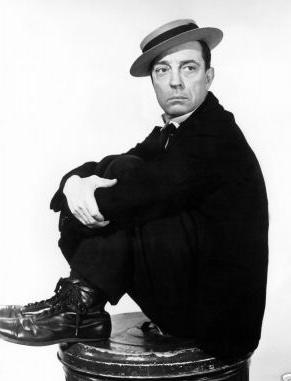
Is it an exaggeration to say that Buster Keaton was the greatest silent clown? I think so. Looking back and comparing his work with the likes of Charlie Chaplin and Harold Lloyd, it becomes increasingly apparent that title shouldn’t belong to anyone. Each great clown had their own particular niche that they filled. Chaplin was the heartwarming, though occasionally naughty Tramp. Lloyd was the devoted everyman. And Buster…Well, he was Old Stoneface. He never asked us to feel for his characters the same way that Chaplin and Lloyd did, but that was part of his power. By not insisting on us caring, he became even more devoted to him.

Born into a vaudeville family, he gained the nickname “Buster” at a young age when he fell down a flight of stairs at eighteen months old. When he walked away unharmed, a bemused Harry Houdini said, “That was a real buster!” And so Buster’s fate was set. He would make a career out of being thrown, hit, beaten, smacked, slapped, shook, abused, and pulverized. When he was a child he would join his parents onstage where he would take part in the act. He had a suitcase handle sewn into his clothing so that his father could throw him all over the stage, into the audience, and even into the orchestra pit. And yet, Buster was never hurt. He learned how to fall in such a way that he could take great physical punishment without being hurt. No matter what happened to him, he would maintain a straight face, discovering that it would get a bigger laugh. As he grew older, his ability to maintain his serious look gave him the nickname “Old Stoneface.” When he finally began making films, he transferred this persona to the silver screen and created one of the cinema’s most enduring characters.

Named by many as one of the greatest actor/directors of all time, his list of films read like a collection of greatest hits: Our Hospitality (1923), Sherlock, Jr. (1924), Seven Chances (1925), The General (1927), and Steamboat Bill Jr. (1928). Each one of these films has gone down in history as a classic. Unfortunately, it is universally agreed that his work faltered when he signed on with MGM in 1928, a move that would strip all creative control from his future projects. But in 1934 he managed to make some truly decent two-reel comedies with Educational Pictures. But they are mostly overlooked. For film audiences everywhere, ol’ Buster was past his prime and stinking.

But what of Buster’s onscreen persona? Well, like Chaplin’s the Tramp, he played the same character in every film, just in different times and situations. Examining all of his work, patterns begin to appear. For example, how many people have realized that the girl that Buster goes for always treats him like dirt? Unlike the Tramp who had to struggle to get the dame’s attention, Buster was already acquainted with the girl. Most of the time she would hold him in contempt and Buster would spend the rest of the film trying to earn her love. Take The General where the woman won’t even speak to him unless he joins the Confederate Army in the Civil War. A sane person would forget about a girl who was so cruel, but not Buster. It was just another obstacle for him. But then, how many people have noticed that he has quite a cruel streak in his films, frequently attempting or threatening suicide if he fails his appointed tasks? The ending of Cops (1922) has him on the run from the police only to give himself up when the girl ignores him. That film ends with a still of a tombstone with the words “The End” written on them with one of Buster’s trademark pork pie hats propped up on it.


So instead of calling Buster a character that never gives up, I would classify him as a man who has an established goal and is willing to do anything to reach that end. That would explain his behavior in a rare gem of a movie entitled Grand Slam Opera, a talkie made in 1936 long past what most critics considered his prime. In it, we see Buster trying to become a radio star, even though he can’t sing and fully intends to do physical comedy. What results is a hysterical, but poignant look into the world of Buster Keaton and the aftermath of the Hollywood talkie takeover which killed the careers of so many silent film stars.

The film starts with Buster leaving on a train from his Arizona home to go to New York where he hopes to make it big in radio. The very first scene has him singing goodbye to the people who gathered to see him off. This scene has a surreal quality, if only because audiences are not accustomed to seeing a silent film star sing. But once the initial shock of hearing his voice wears off, the movie then truly begins for the audience. On the streets of New York, he bumps into a pretty girl, who like so many other pretty girls in Buster movies, insults him and brushes him off. She admonishes him only like a child. Buster sincerely replies, “How about a little dinner and a show?” In a joke that Buster had used several times before in his career, a trolley rolls past them, obstructing our view of the couple. When it passes, the girl has disappeared, supposedly on the train. Buster’s response is to shrug and move on. He has more important things to worry about. He needs to prepare for his radio audition tomorrow.

What follows is one of the film’s two great comedic sequences. Trapped in a tiny hotel room, he goes about trying to come up with an act for the radio show. He tries singing, but in a move that may be a passive aggressive sneer against the new talkie industry, he can only produce tortured yelps. So, he tries balancing a bowling ball on a pool cue. When that doesn’t work, he tries to come up with a dance number when he spies a picture of Fred Astaire on his bedside table. In a great show of acrobatic skill, he dances all over the room, on the bed, on the tables, and on top of the counters like Fred Astaire would. This is a poignant piece of comedy when you consider that he is impersonating the very men who put his generation of Hollywood actors out of work. When the noise gets too loud, it annoys the occupant of the room below Buster’s. Of course, she is the same girl as before. After telling him off, once again he asks the question, “How about a little dinner and a show?” When she once again refuses, he grabs some sand from a fire extinguisher in the hall, throws it all over the floor, and slips and slides to a new song. All of this is perfectly executed slapstick done with no dialogue. It is a testament to Buster’s skill that he could be such a great silent clown even when it was no longer popular.

If the first sequence was a tribute to his old career, the next one has him embracing the new use of sound in the movies. Waiting outside of the recording room, he hears a group of musicians auditioning for a spot on the show. They play a medley of world music. Not knowing this, Buster dances along with the music outside of the door. As the music changes, so does Buster’s dancing. It is an incredibly effective scene reminiscent of the famous gag from Sherlock Jr. where he “walks” into a movie screen. But instead of having the humor come from Buster’s reactions to the images, Grand Slam Opera has him reacting to sounds.

Of course there is a happy ending. As suspected, it ends with him holding the dame and asking for a third time, “How about a little dinner and a show?” Only this time she agrees. He is now a rich star despite his bungled audition. But what more can we expect from Buster? We want him to get the girl. After all, deep down inside we all know that he deserves it. He spent his entire career being the fall guy, taking all kinds of abuse only to ignore it. And when you consider his struggles with marriage, divorce, and alcoholism in real life, to see him return to such great work after such a great slump is truly a great joy. After all, he may have had a stone face, but he never had a stone heart.


Grand Slam Opera Part 1 of 2


Grand Slam Opera Part 2 of 2