Yes folks...once again this humble blog must go on hiatus. This time I will be MIA from the blogosphere for the entire month of May. I thought that I could juggle this blog and my personal life...but I was mistaken. I have three final papers to write in the next two weeks AND I'm going to be temporarily moving from New York City to Santa Cruz, California. May is going to be an insanely busy month. I just simply won't have the time to write reviews for this site. It break my heart, but that's how it goes. But this site is far from dead, people. When June comes along, I'll be back with brand new reviews! So until then, KEEP CIRCULATING THE TAPES!!
Editor-in-Chief
Nathanael Hood
Sunday, May 6, 2012

Friday, April 20, 2012
Visioneers
Directed by Jared Drake
2008
The United States of America
.jpg)
“This world is a comedy to those that think, a tragedy to those that feel.” - Horace Walpole
George Washington Winsterhammerman hasn’t felt happy in quite some time. Oh sure, he has a enviable life. After all, he has a decent job as a Level Three “TUNT” employee at the Jeffers Corporation, the single largest business in world history which simultaneously maintains de facto control over the United States government. He has a lovely wife, a son, and a massive single family home in the suburbs. As his name suggests, he is even a descendent of the original George Washington, leader of the American Revolution and the first President of the United States. But despite all of these things, George Washington Winsterhammerman isn’t happy. Even worse, he has begun to have dreams when he goes to sleep at night. And everyone knows that having dreams is the first sign that you might explode. See, over 100,000 people have spontaneously exploded for no apparent reason.

George has recently seen a doctor to investigate if he was in danger of exploding, but he was given a clean bill of health, relatively speaking. As the doctor said, “Mr. Winsterhammerman, you seem like someone who’s able to follow orders well, you have a desire to please, you’re a pleasant, affable sort of fellow who doesn’t seem to want much, perhaps just to be included. Judging from the somewhat dull look in your eyes I would rate your intelligence at ‘average.’ All of which is good.” So George Washington Winsterhammerman has everything going in his favor. And yet, he dreams.

Such is the world of Visioneers, the first film by writer-director team Brandon and Jared Drake. The film has been advertised as a black comedy, but I think to do so would be disrespectful. Visioneers is so much more than just a comedy with black humor. Instead, it is a devastating examination of the relationship between tragedy and comedy. Many like to imagine a line, however thin, between the two. But I’ve begun to doubt that comedy and tragedy are two different things. The thought first occurred to me when I recently re-watched Charlie Chaplin’s The Gold Rush (1925), arguably the greatest blend of laughter and tears ever committed to the screen. In the famous bread-roll dance scene, I couldn’t figure out whether to laugh at Chaplin’s antics or weep at the cruelty of the women who tricked him. I frequently felt the same emotion while watching Visioneers. On the one hand I wanted to laugh at the scenes that demonstrated the complete absurdity of George’s world. Who wouldn’t laugh at a society where flipping your middle finger and saying "Jeffers morning" was a standard greeting?

George’s wife watches a show where women discuss how the use of “vaginal butter” and the ownership of 12-gauge shotguns are the keys to staying happy!

On the ride home from work, George is serenaded by radio commercials with such infectious jingles as:
If you wanna be happy and have lots of friends,
Eat fried chicken, fried chicken makes a difference.
And if you wanna have fun and not blow to pieces,
Eat fried chicken, fried chicken, it’s delicious!

And yet, all of the laughter makes one feel nervous and uncomfortable. It’s very clear that George lives in a truly hellish society where genuine emotions and feelings are repressed and replaced by kitschy, artificial substitutes such as television, consumer goods, and blind loyalty to the Jeffers Corporation.

When George’s brother Julieen, a former Level Five employee, moves into his pool-house after quitting his job, we view him as an amusing oddity despite the fact that he is clearly the only person we’ve seen who is actually happy and content with his life. His achievement of what we as the viewers view as normalcy make him an outsider. In another scene, to combat the increase of explosion cases the Jeffers Corporation forces its employees to wear silly outfits and hug giant teddy bears. At first, we laugh. But when one of George’s co-workers has a particularly violent reaction to the overstuffed animals, our hearts sink into our stomachs. Yes, there is humor in this world. But it comes at the expense of its occupants’ very humanity.

Eventually George seeks solace in the form of his ex-boss Charisma who was suddenly fired. He discovers her working in her father’s cafe in an “undeveloped” part of the country. They find a glimmer of hope and happiness in each other. But the powers that be conspire to try and keep them apart. From there George’s world continues to collapse. Julieen is violently taken into custody by government agents. The government suddenly declares explosions as a “threat to our way of life” and begins a campaign to install thought inhibitors into all of its citizens. These inhibitors are, of course, manufactured and distributed by the Jeffers Corporation. Media personalities start to blow up during live broadcasts. In one of the film’s most devastating scenes, George and his wife witness the “vaginal butter” lady suffer a mental breakdown when she learns that she has been instructed to tell people that “happiness is being happy.”

I won’t reveal what happens in the last few scenes because I believe that it is something that you have to experience for yourself. I won’t even say if it’s happy or sad. You need to see it with your own two eyes. It is the perfect conclusion to the Drake brothers first film. I praise a lot of films as part of my job as a movie critic. As such, I can say that some films have better acting than Visioneers, although Zach Galifianakis’ performance as George would have easily earned an Oscar nod if it had gained a wider release. Some films have better cinematography. And some films demonstrate a greater level of craftsmanship. But despite this, Visioneers is truly something special. Since first watching it, the film has haunted my dreams and occupied my fantasies. There is something so basic, so primitive, and so pure at the heart of Visioneers that it stands in a league of its own. Most Oscar winners wish that they could claim the same.
2008
The United States of America
.jpg)
“This world is a comedy to those that think, a tragedy to those that feel.” - Horace Walpole
George Washington Winsterhammerman hasn’t felt happy in quite some time. Oh sure, he has a enviable life. After all, he has a decent job as a Level Three “TUNT” employee at the Jeffers Corporation, the single largest business in world history which simultaneously maintains de facto control over the United States government. He has a lovely wife, a son, and a massive single family home in the suburbs. As his name suggests, he is even a descendent of the original George Washington, leader of the American Revolution and the first President of the United States. But despite all of these things, George Washington Winsterhammerman isn’t happy. Even worse, he has begun to have dreams when he goes to sleep at night. And everyone knows that having dreams is the first sign that you might explode. See, over 100,000 people have spontaneously exploded for no apparent reason.

George Washington Winsterhammerman
George has recently seen a doctor to investigate if he was in danger of exploding, but he was given a clean bill of health, relatively speaking. As the doctor said, “Mr. Winsterhammerman, you seem like someone who’s able to follow orders well, you have a desire to please, you’re a pleasant, affable sort of fellow who doesn’t seem to want much, perhaps just to be included. Judging from the somewhat dull look in your eyes I would rate your intelligence at ‘average.’ All of which is good.” So George Washington Winsterhammerman has everything going in his favor. And yet, he dreams.

Such is the world of Visioneers, the first film by writer-director team Brandon and Jared Drake. The film has been advertised as a black comedy, but I think to do so would be disrespectful. Visioneers is so much more than just a comedy with black humor. Instead, it is a devastating examination of the relationship between tragedy and comedy. Many like to imagine a line, however thin, between the two. But I’ve begun to doubt that comedy and tragedy are two different things. The thought first occurred to me when I recently re-watched Charlie Chaplin’s The Gold Rush (1925), arguably the greatest blend of laughter and tears ever committed to the screen. In the famous bread-roll dance scene, I couldn’t figure out whether to laugh at Chaplin’s antics or weep at the cruelty of the women who tricked him. I frequently felt the same emotion while watching Visioneers. On the one hand I wanted to laugh at the scenes that demonstrated the complete absurdity of George’s world. Who wouldn’t laugh at a society where flipping your middle finger and saying "Jeffers morning" was a standard greeting?

"Jeffers morning, everyone."
George’s wife watches a show where women discuss how the use of “vaginal butter” and the ownership of 12-gauge shotguns are the keys to staying happy!

On the ride home from work, George is serenaded by radio commercials with such infectious jingles as:
If you wanna be happy and have lots of friends,
Eat fried chicken, fried chicken makes a difference.
And if you wanna have fun and not blow to pieces,
Eat fried chicken, fried chicken, it’s delicious!

Can't argue with that logic.
And yet, all of the laughter makes one feel nervous and uncomfortable. It’s very clear that George lives in a truly hellish society where genuine emotions and feelings are repressed and replaced by kitschy, artificial substitutes such as television, consumer goods, and blind loyalty to the Jeffers Corporation.

Say hello to Mr. Jeffers.
When George’s brother Julieen, a former Level Five employee, moves into his pool-house after quitting his job, we view him as an amusing oddity despite the fact that he is clearly the only person we’ve seen who is actually happy and content with his life. His achievement of what we as the viewers view as normalcy make him an outsider. In another scene, to combat the increase of explosion cases the Jeffers Corporation forces its employees to wear silly outfits and hug giant teddy bears. At first, we laugh. But when one of George’s co-workers has a particularly violent reaction to the overstuffed animals, our hearts sink into our stomachs. Yes, there is humor in this world. But it comes at the expense of its occupants’ very humanity.

Let's just say that what happens next isn't pretty.
Eventually George seeks solace in the form of his ex-boss Charisma who was suddenly fired. He discovers her working in her father’s cafe in an “undeveloped” part of the country. They find a glimmer of hope and happiness in each other. But the powers that be conspire to try and keep them apart. From there George’s world continues to collapse. Julieen is violently taken into custody by government agents. The government suddenly declares explosions as a “threat to our way of life” and begins a campaign to install thought inhibitors into all of its citizens. These inhibitors are, of course, manufactured and distributed by the Jeffers Corporation. Media personalities start to blow up during live broadcasts. In one of the film’s most devastating scenes, George and his wife witness the “vaginal butter” lady suffer a mental breakdown when she learns that she has been instructed to tell people that “happiness is being happy.”

I won’t reveal what happens in the last few scenes because I believe that it is something that you have to experience for yourself. I won’t even say if it’s happy or sad. You need to see it with your own two eyes. It is the perfect conclusion to the Drake brothers first film. I praise a lot of films as part of my job as a movie critic. As such, I can say that some films have better acting than Visioneers, although Zach Galifianakis’ performance as George would have easily earned an Oscar nod if it had gained a wider release. Some films have better cinematography. And some films demonstrate a greater level of craftsmanship. But despite this, Visioneers is truly something special. Since first watching it, the film has haunted my dreams and occupied my fantasies. There is something so basic, so primitive, and so pure at the heart of Visioneers that it stands in a league of its own. Most Oscar winners wish that they could claim the same.
Wednesday, April 11, 2012
Fury
Directed by Fritz Lang
1936
The United States of America

There is a famous scene in Fritz Lang’s M (1931) where a group of townspeople suddenly mob a random man during a panic caused by a recent string of child murders. The unsuspecting man had made the mistake of giving a little girl the time of day. At first, a large man appears and accuses him of bothering the girl. When the man rightfully objects, onlookers swarm around him. Raised voices lead to shouts. Shouts lead to screams. And before the poor man can object, he is attacked by the crowd. Five years after Lang released M, he would direct another penetrating examination of mob mentality and crowd psychology. It would be the first film Lang directed after fleeing to the United States from the looming specter of Nazism. Loosely based on a real life incident where two men were lynched in Santa Clara, California in 1933, the film, simply titled Fury, would prove to be one of Lang’s most angry and cynical.
At the beginning of the film we find Joe Wilson, a well-meaning auto mechanic, as he embarks on a long journey to meet his fiancée, Katherine Grant, in California. These early scenes chug along with an obnoxious, plasticine kitsch. Joe, played by Spencer Tracy, seems a bit too idealistic and well-off for an auto mechanic, happily popping an occasional peanut in his mouth from his pocket as he laughs at the world around him. Katherine, played by Sylvia Sidney, seems a bit too doe-eyed and innocent. The world seems a bit too bright and friendly. Indeed, one could easily be fooled into thinking that the projector had accidentally run the wrong film. Is this the same Fritz Lang whose most famous film involved a child murderer?

But things take an unusual turn during Joe’s journey. He stops in a small town for some gas. However, the townsfolk seem strangely unnerved, their eyes swiftly shifting all over this outsider. Unbeknownst to Joe, the town had recently suffered the loss of a little girl to two kidnappers. And even more unfortunately for Joe, one of the kidnappers supposedly had a fondest for peanuts. The sheriff decides to hold Joe overnight while they investigate him. However, rumor and hearsay quickly spreads throughout the town that the sheriff has one of the kidnappers in the jail. The police stripped Joe’s car in the search for ransom money, but failed to find any. However tales start to spread about how the “prisoner” had a suspicious amount of money in his possession. How much? $100! No, $1,000! No, it was $10,000! Gossip swirls around until the townsfolk are convinced that the police are holding a vicious, unrepentant kidnapper who was caught with all the ransom money.

A mob forms. The sheriff tries to maintain the peace, but the people are restless. Sensing a possible riot, the sheriff calls in the National Guard. But word reaches the governor who stops them from being deployed. He’s up for re-election, y’see, and voters don’t like it when the National Guard gets involved in their business. The crowd loses control and storms the jailhouse. When they are blocked by the sheriff and his deputies, they set the jailhouse on fire, laughing and jeering at the heinous criminal getting his just reward.
 Miraculously, Joe survived the fire and escaped. However, having survived a lynching, Joe Wilson is a changed man. He desires nothing more than vengeance on his would-be killers. When twenty-two townsfolk are put on trial for his murder, he gleefully listens as they slowly crack under pressure. He knows that if found guilty, the townsfolk would be given the death penalty. But he doesn’t care. He wants them to suffer. When the trial seems to stall from lack of evidence, he quickly mails the judge incriminating memento as an “anonymous towns-member.” Soon Katherine discovers that Joe is alive and begs for him to appear before the court, thereby saving the townsfolk’s lives. What is Joe to do? Appear and let off the people who gladly tried to murder him without evidence or a trial? Or should he let them the ultimate punishment?
With Fury, Lang rips asunder the picturesque image of small-town America. The seemingly incorruptible American justice system is ultimately wielded by Joe Wilson to prosecute the townsfolk. Rather than trying to correct an egregious sin, the townsfolk become entombed in silence, refusing to indicate any of their peers as members of the lynch mob. While a news camera captured several hundred people participating in the mob, the entire population of the town was apparently “asleep that night” or “out at their cabin in the woods.” Even Spencer Tracy, no stranger to diverse roles but usually associated with kind characters, transforms into a snarling, angry shadow of his former self.

It has been argued that once Lang moved to America he lost his eye for formal composition and ultra-stylized cinematography. However, Fury proves this assumption wrong. The striking black-and-white photography, courtesy of Joseph Ruttenberg, transforms the town and courthouse into hellish reflections of man’s most primal nature. It also warrants mention that Lang had not yet lost his taste for silent film language while making Fury. There are several scenes that demonstrate his skill for storytelling with visual language. Take an early scene where the town gossip mill first begins to turn. We are treated to several shots of different people embellishing the story with each re-telling. At one point, a flock of squawking hens are superimposed on top of a couple of gossiping old ladies. Such a sequence makes perfect sense for those familiar with silent film language. However, if such a technique was used in a modern movie, it would probably be received with raucous laughter.


What could have been a simple courtroom crime drama was wielded to make no less a commentary on American society as M was to Weimar Germany. While Lang would go on to make several of his greatest films in America, for many, once he left Europe the thrill was gone. Once he was crushed into the unforgiving mold of the Hollywood studio system, Lang became just another peddler of cheap B-movies. But these people are wrong. Just one viewing of Fury will suffice to silence them.
1936
The United States of America

There is a famous scene in Fritz Lang’s M (1931) where a group of townspeople suddenly mob a random man during a panic caused by a recent string of child murders. The unsuspecting man had made the mistake of giving a little girl the time of day. At first, a large man appears and accuses him of bothering the girl. When the man rightfully objects, onlookers swarm around him. Raised voices lead to shouts. Shouts lead to screams. And before the poor man can object, he is attacked by the crowd. Five years after Lang released M, he would direct another penetrating examination of mob mentality and crowd psychology. It would be the first film Lang directed after fleeing to the United States from the looming specter of Nazism. Loosely based on a real life incident where two men were lynched in Santa Clara, California in 1933, the film, simply titled Fury, would prove to be one of Lang’s most angry and cynical.
At the beginning of the film we find Joe Wilson, a well-meaning auto mechanic, as he embarks on a long journey to meet his fiancée, Katherine Grant, in California. These early scenes chug along with an obnoxious, plasticine kitsch. Joe, played by Spencer Tracy, seems a bit too idealistic and well-off for an auto mechanic, happily popping an occasional peanut in his mouth from his pocket as he laughs at the world around him. Katherine, played by Sylvia Sidney, seems a bit too doe-eyed and innocent. The world seems a bit too bright and friendly. Indeed, one could easily be fooled into thinking that the projector had accidentally run the wrong film. Is this the same Fritz Lang whose most famous film involved a child murderer?

Joe setting off on his trip. There are WAY too many people smiling in this picture for it to be from a Fritz Lang film...
But things take an unusual turn during Joe’s journey. He stops in a small town for some gas. However, the townsfolk seem strangely unnerved, their eyes swiftly shifting all over this outsider. Unbeknownst to Joe, the town had recently suffered the loss of a little girl to two kidnappers. And even more unfortunately for Joe, one of the kidnappers supposedly had a fondest for peanuts. The sheriff decides to hold Joe overnight while they investigate him. However, rumor and hearsay quickly spreads throughout the town that the sheriff has one of the kidnappers in the jail. The police stripped Joe’s car in the search for ransom money, but failed to find any. However tales start to spread about how the “prisoner” had a suspicious amount of money in his possession. How much? $100! No, $1,000! No, it was $10,000! Gossip swirls around until the townsfolk are convinced that the police are holding a vicious, unrepentant kidnapper who was caught with all the ransom money.

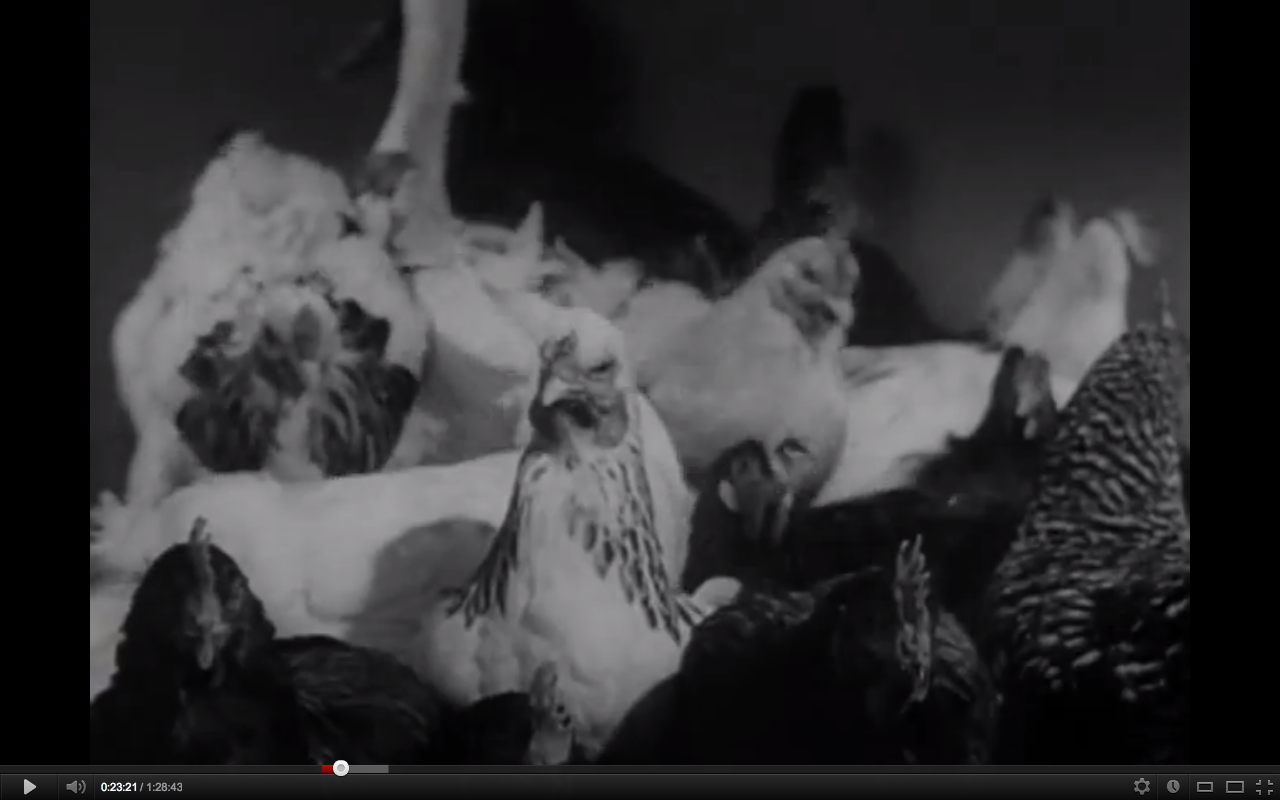
The gossip spreads...
A mob forms. The sheriff tries to maintain the peace, but the people are restless. Sensing a possible riot, the sheriff calls in the National Guard. But word reaches the governor who stops them from being deployed. He’s up for re-election, y’see, and voters don’t like it when the National Guard gets involved in their business. The crowd loses control and storms the jailhouse. When they are blocked by the sheriff and his deputies, they set the jailhouse on fire, laughing and jeering at the heinous criminal getting his just reward.
 Miraculously, Joe survived the fire and escaped. However, having survived a lynching, Joe Wilson is a changed man. He desires nothing more than vengeance on his would-be killers. When twenty-two townsfolk are put on trial for his murder, he gleefully listens as they slowly crack under pressure. He knows that if found guilty, the townsfolk would be given the death penalty. But he doesn’t care. He wants them to suffer. When the trial seems to stall from lack of evidence, he quickly mails the judge incriminating memento as an “anonymous towns-member.” Soon Katherine discovers that Joe is alive and begs for him to appear before the court, thereby saving the townsfolk’s lives. What is Joe to do? Appear and let off the people who gladly tried to murder him without evidence or a trial? Or should he let them the ultimate punishment?
With Fury, Lang rips asunder the picturesque image of small-town America. The seemingly incorruptible American justice system is ultimately wielded by Joe Wilson to prosecute the townsfolk. Rather than trying to correct an egregious sin, the townsfolk become entombed in silence, refusing to indicate any of their peers as members of the lynch mob. While a news camera captured several hundred people participating in the mob, the entire population of the town was apparently “asleep that night” or “out at their cabin in the woods.” Even Spencer Tracy, no stranger to diverse roles but usually associated with kind characters, transforms into a snarling, angry shadow of his former self.
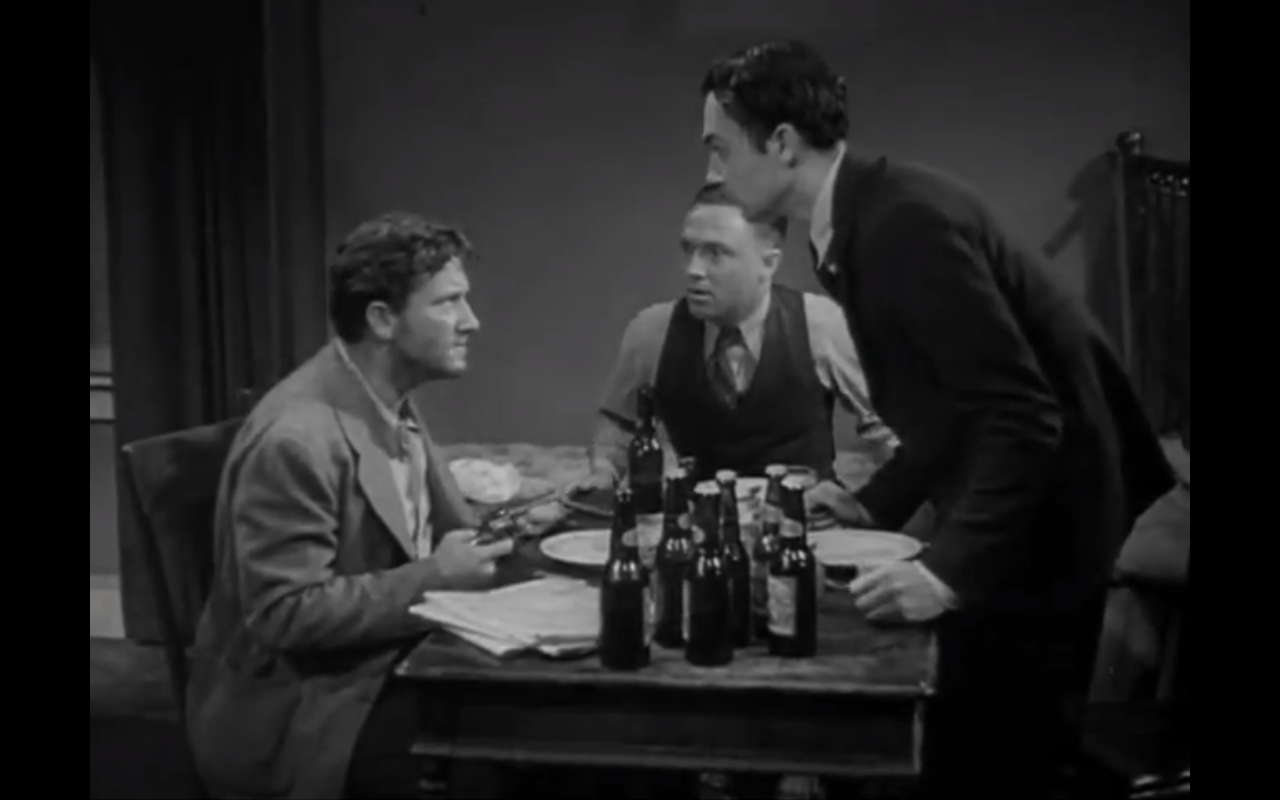
Joe Wilson threatening his loved ones to keep quiet that he's alive.
It has been argued that once Lang moved to America he lost his eye for formal composition and ultra-stylized cinematography. However, Fury proves this assumption wrong. The striking black-and-white photography, courtesy of Joseph Ruttenberg, transforms the town and courthouse into hellish reflections of man’s most primal nature. It also warrants mention that Lang had not yet lost his taste for silent film language while making Fury. There are several scenes that demonstrate his skill for storytelling with visual language. Take an early scene where the town gossip mill first begins to turn. We are treated to several shots of different people embellishing the story with each re-telling. At one point, a flock of squawking hens are superimposed on top of a couple of gossiping old ladies. Such a sequence makes perfect sense for those familiar with silent film language. However, if such a technique was used in a modern movie, it would probably be received with raucous laughter.


What could have been a simple courtroom crime drama was wielded to make no less a commentary on American society as M was to Weimar Germany. While Lang would go on to make several of his greatest films in America, for many, once he left Europe the thrill was gone. Once he was crushed into the unforgiving mold of the Hollywood studio system, Lang became just another peddler of cheap B-movies. But these people are wrong. Just one viewing of Fury will suffice to silence them.
Saturday, March 31, 2012
An Apology
Hello everyone!
I'm sorry to say that I was only able to do two reviews this month. School has been absolutely insane. But I will try to get back to my regular quota of four reviews a month as soon as possible.
Thanks for reading!
Nathanael Hood
I'm sorry to say that I was only able to do two reviews this month. School has been absolutely insane. But I will try to get back to my regular quota of four reviews a month as soon as possible.
Thanks for reading!
Nathanael Hood
Sunday, March 25, 2012
Shallow Grave
Directed by Danny Boyle
1994
The United Kingdom

Off a nondescript street in an equally nondescript neighborhood of Edinburgh stands an unassuming brownstone flat harboring three particularly nasty tenets. The first, David, is a mousy-looking chartered accountant sporting a Clark Kent combover and a pair of garish brown glasses. The second, Juliet, is a stern, no-nonsense doctor who seems to have stolen her hairdo and demeanor from a 1980s female news anchor. And finally, the third is Alex, a grating, immature, irresponsible reporter with a massive ego outsized only by his gargantuan mouth. The three would have probably hated each other if not for one common interest: causing misery in other human beings. When they aren’t working or keeping their split-pea soup green and Tweety Bird yellow furniture and decor immaculately clean, the three emotionally and psychologically abuse the unfortunate souls who answer their add for a fourth tenet.

But soon they run out of awkward Gingers, Goths, and Geeks to harass. So they finally accept a clean-cut, well dressed man named Hugo as their fourth tenet. Everything seems fine...at least until the next day when they discover him completely naked, sprawled out over his bed, and stone-cold dead from a drug overdose. And next to their freshly deceased flatmate they find a suitcase stuffed to the brim with more money than they had ever laid eyes on.

Such is the situation in which the main characters of Danny Boyle’s directorial debut Shallow Grave find themselves. Two years before he would stun the world with Trainspotting (1996), a true cinematic triumph that would later be named one of the Top Ten Greatest British Films of All Time by the British Film Institute, Boyle released this remarkable, yet little remembered, title. Part crime thriller, part black comedy, Shallow Grave is a magnificent synthesis of style, mood, and storytelling.
The idea of a group of friends accidentally discovering a suitcase full of somebody else’s money was already an overused stereotype before Boyle began this film. But Boyle introduces two distinct variations for this scenario which set it apart from other stories of its kind. First, usually when a group of people find a “suitcase full of money” they initially want to do the right thing but are dissuaded by a corrupt member of their party. In Shallow Grave, Boyle asks the question of what would happen if the people who found it were already out-right, unapologetic bastards. It doesn’t take long for the three to decide to keep the money and not inform the authorities about Hugo’s death. So they almost immediately set out on the obligatory spending sprees that accompany such tales.

Well, to be more specific, Juliet and Alex start to throw money around like crazy. David, on the other hand, refrains from and even rebukes their frivolous behavior, wisely (and correctly) assuming that the money didn’t belong to Hugo. But there is a greater motivation for David’s cautious behavior. Quite simply, he begins to grow a conscience. Usually it’s the other way around in these stories: a harming individual or influence eventually corrupts the otherwise decent members of the group who find the money, eventually turning them against each other. The reason for David’s sudden development has to do with Boyle’s second variation on this story: the presence of an unwanted body.

Naturally Hugo has to disappear in order for them to keep the money. But the question quickly becomes how will they do it. The disposal of bodies has long been one of the most difficult problems for the average movie character. Some hide them under floorboards, some in swamps, and some even feed them to pigs! But David, Juliet, and Alex fancy themselves smarter than the average criminal and decide that the best thing to do is to saw off his hands and feet, burn them, bash his face with a hammer beyond recognition, destroy his teeth, and bury what’s left in the woods. Unfortunately, after drawing straws, it is up for David to do the butchering. It is at this point that the film takes on a completely different tone.

Up until then, the entire film had reveled in the techniques that would come to define Boyle’s direction in the coming decades: highly kinetic editing, a break-neck speed, and ecstatically energetic acting. But after David’s midnight meat run, the mood and atmosphere of the film shift. David slowly begins to lose his mind, locking himself in their attic to protect the money. A pair of gangsters hot on the trail of the money begin to interrogate and dispatch people connected with the money’s disappearance in increasingly shocking and brutal manners. Juliet begins to realize that they might be in trouble and starts to move about as if in a daze. And Alex, whereas before he was just an asshole, begins to sink into illusions of grandeur wherein he is a genius and completely untouchable by both the law and whoever might be wanting the money back.

Of course, Alex’s delusions are violently ended when the two gangsters somehow track the money to their flat and attack them. Miraculously, David manages to dispatch both of them when they try to access the attic. Afterwards, they have two more dead bodies to dispose of. But they have bigger problems. David’s paranoia has driven him insane, Juliet is so terrified that she buys plane tickets to Brazil, and Alex’s arrogant bravado has come crashing down, leaving him a frightened fraction of the man he once was. To their combined horror, things get even worse when the police manage to discover all three bodies and come to their flat asking suspicious questions. Perhaps inevitably it leads to an unfortunate incident in their flat involving a particularly large kitchen knife...

Though its central story may be too familiar for some, Danny Boyle’s Shallow Grave is nonetheless an astonishingly powerful thriller. Most films are unable to survive a mood shift as severe and pronounced as the one central to Shallow Grave. But where other films choke, Shallow Grave succeeds with a ferocious intensity. Many fresh filmmakers make the mistake of sacrificing story for style. But with this film Boyle proved himself not only as a master stylist, but as a supreme storyteller as well. Truly, it was the dawn of one of Britain’s greatest and most talented modern filmmakers.
1994
The United Kingdom

Off a nondescript street in an equally nondescript neighborhood of Edinburgh stands an unassuming brownstone flat harboring three particularly nasty tenets. The first, David, is a mousy-looking chartered accountant sporting a Clark Kent combover and a pair of garish brown glasses. The second, Juliet, is a stern, no-nonsense doctor who seems to have stolen her hairdo and demeanor from a 1980s female news anchor. And finally, the third is Alex, a grating, immature, irresponsible reporter with a massive ego outsized only by his gargantuan mouth. The three would have probably hated each other if not for one common interest: causing misery in other human beings. When they aren’t working or keeping their split-pea soup green and Tweety Bird yellow furniture and decor immaculately clean, the three emotionally and psychologically abuse the unfortunate souls who answer their add for a fourth tenet.

Juliet, Alex, and David immediately after humiliating another potential flatmate.
But soon they run out of awkward Gingers, Goths, and Geeks to harass. So they finally accept a clean-cut, well dressed man named Hugo as their fourth tenet. Everything seems fine...at least until the next day when they discover him completely naked, sprawled out over his bed, and stone-cold dead from a drug overdose. And next to their freshly deceased flatmate they find a suitcase stuffed to the brim with more money than they had ever laid eyes on.

Such is the situation in which the main characters of Danny Boyle’s directorial debut Shallow Grave find themselves. Two years before he would stun the world with Trainspotting (1996), a true cinematic triumph that would later be named one of the Top Ten Greatest British Films of All Time by the British Film Institute, Boyle released this remarkable, yet little remembered, title. Part crime thriller, part black comedy, Shallow Grave is a magnificent synthesis of style, mood, and storytelling.
The idea of a group of friends accidentally discovering a suitcase full of somebody else’s money was already an overused stereotype before Boyle began this film. But Boyle introduces two distinct variations for this scenario which set it apart from other stories of its kind. First, usually when a group of people find a “suitcase full of money” they initially want to do the right thing but are dissuaded by a corrupt member of their party. In Shallow Grave, Boyle asks the question of what would happen if the people who found it were already out-right, unapologetic bastards. It doesn’t take long for the three to decide to keep the money and not inform the authorities about Hugo’s death. So they almost immediately set out on the obligatory spending sprees that accompany such tales.

The aftermath.
Well, to be more specific, Juliet and Alex start to throw money around like crazy. David, on the other hand, refrains from and even rebukes their frivolous behavior, wisely (and correctly) assuming that the money didn’t belong to Hugo. But there is a greater motivation for David’s cautious behavior. Quite simply, he begins to grow a conscience. Usually it’s the other way around in these stories: a harming individual or influence eventually corrupts the otherwise decent members of the group who find the money, eventually turning them against each other. The reason for David’s sudden development has to do with Boyle’s second variation on this story: the presence of an unwanted body.

I mean, it IS kinda hard to miss.
Naturally Hugo has to disappear in order for them to keep the money. But the question quickly becomes how will they do it. The disposal of bodies has long been one of the most difficult problems for the average movie character. Some hide them under floorboards, some in swamps, and some even feed them to pigs! But David, Juliet, and Alex fancy themselves smarter than the average criminal and decide that the best thing to do is to saw off his hands and feet, burn them, bash his face with a hammer beyond recognition, destroy his teeth, and bury what’s left in the woods. Unfortunately, after drawing straws, it is up for David to do the butchering. It is at this point that the film takes on a completely different tone.

David doing the dirty deed.
Up until then, the entire film had reveled in the techniques that would come to define Boyle’s direction in the coming decades: highly kinetic editing, a break-neck speed, and ecstatically energetic acting. But after David’s midnight meat run, the mood and atmosphere of the film shift. David slowly begins to lose his mind, locking himself in their attic to protect the money. A pair of gangsters hot on the trail of the money begin to interrogate and dispatch people connected with the money’s disappearance in increasingly shocking and brutal manners. Juliet begins to realize that they might be in trouble and starts to move about as if in a daze. And Alex, whereas before he was just an asshole, begins to sink into illusions of grandeur wherein he is a genius and completely untouchable by both the law and whoever might be wanting the money back.

Of course, Alex’s delusions are violently ended when the two gangsters somehow track the money to their flat and attack them. Miraculously, David manages to dispatch both of them when they try to access the attic. Afterwards, they have two more dead bodies to dispose of. But they have bigger problems. David’s paranoia has driven him insane, Juliet is so terrified that she buys plane tickets to Brazil, and Alex’s arrogant bravado has come crashing down, leaving him a frightened fraction of the man he once was. To their combined horror, things get even worse when the police manage to discover all three bodies and come to their flat asking suspicious questions. Perhaps inevitably it leads to an unfortunate incident in their flat involving a particularly large kitchen knife...

Though its central story may be too familiar for some, Danny Boyle’s Shallow Grave is nonetheless an astonishingly powerful thriller. Most films are unable to survive a mood shift as severe and pronounced as the one central to Shallow Grave. But where other films choke, Shallow Grave succeeds with a ferocious intensity. Many fresh filmmakers make the mistake of sacrificing story for style. But with this film Boyle proved himself not only as a master stylist, but as a supreme storyteller as well. Truly, it was the dawn of one of Britain’s greatest and most talented modern filmmakers.
Saturday, March 24, 2012
Last Chants for a Slow Dance
Directed by Jon Jost
1977
The United States of America

Somewhere along a desolate highway in Western Montana where the scorched grass burns brown and cotton-ball clouds dissolve into an endless ocean of white, a decrepit old pick-up truck speeds along. The driver, a shifty, uneasy man named Tom Bates fidgets and cackles a rapid, kookaburra laugh. “I mean, what you ever get the feeling that everything was just, just going by you like WHOOSH -- just going by, it’s all, all too fast. You can’t, can’t see anything,” he philosophizes to a lanky hitch-hiking hippie sitting in the passenger seat. “I guess, well I guess what I got to do is sort through some of this shit, y’know, just get some of this shit outta my life,” he continues as his passenger sits in solemn silence. Indeed, Tom Bates is a man with a lot of shit in his life. He has no job, no money, a wife he keeps running away from, and two kids (soon to be three) he doesn’t want. And the worst part is that he is either incapable or unwilling to realize or admit that all of these problems are his fault. He is the nightmare of a living, breathing hamartia; an Aristotelian tragic hero devoid of anagnorisis. He is unapologetic in all he does: when he screams at his wife, when he wastes what little money he has on cheap drinks, and even when he cruelly throws the hippie out of his truck when he begins to suspect that he might be “a queer.” He feels cheated by life, yet has no idea that he stacked his own deck against him.

Such are the ways of Tom Bates, the character around which Jon Jost’s Last Chants for a Slow Dance revolves. One of the neglected treasures of the early American independent film scene, it is, to use Jonathan Rosenbaum’s words, a “chilling portrait of an embittered, misogynistic lumpen proletarian.” Made for about $2,000 and shot on dusty, faded 16mm film stock, the film looks like the remnants of overexposed home movies. It embodies the lulling sense of fatigue brought on by days of endless driving with no radio or air conditioning. And yet there was not a single moment of Last Chants for a Slow Dance that didn’t leave me completely enthralled.

Jost constructs his film through the use of two primary techniques. First, he routinely utilizes long takes where the characters are either partially or completely obscured. Consider the opening scene in the truck with the hippie hitch-hiker. The third shot of this sequence is a medium close-up of Tom Bates and the hippie framed by the front windshield. The camera first focuses on Tom.

Since up to this point the hippie hasn’t said a word, the audiences is shocked when the camera pans left to reveal his presence.

Then, the camera pans further left to profile the hippie. All the while, Tom continues to rattle on from off-camera.

Then, after a time, the camera pans right to frame both characters one last time.

This whole unbroken shot is roughly six minutes long. Not only is it aesthetically fascinating, but it is a technical marvel. Considering that Jost only had two grand to film with, it is very doubtful that he had an expensive camera that could be fixed on the top of the engine. So this raises two possibilities. One, that Jost managed to cobble together a system of pulleys and ropes which not only held the camera in place but panned it back and forth to perfectly profile the characters. Two, that somebody was literally tied to the front of the truck and worked the camera while on a busy freeway. I honestly can’t decide which would be more practical.
The second technique that Jost extensively utilizes is the montage. As Tom stumbles from confrontation to confrontation, the film dissolves into sequences of rapid, quick cuts set to country music written, played, and sung by Jost. When I say country music, I don’t mean the polished, glittery Nashville tripe that usually floods the radio-waves. This is authentic country music, the kind Townes Van Zandt crooned to empty bar rooms in Austin, the kind borne from picking on a guitar or banjo on a rocking chair on a front porch, the kind that paints pictures of misery, despondence, and exhaustion. The music evokes the tedium that rules Tom’s life.
The combination of the long take and montage skew the audience’s senses of temporality. On this subject, Noël Carroll wrote, “Jost’s strength in this film is his ability to portray the experience of time of the lumpenproietariat who is outside the regimented rhythm of work and sleep, who lives without directions, schedules, and goals.” And indeed, Tom seems drifts in and out of time. One minute, he is flirting with a woman at a bar. In the next, we see Tom sitting on the bed in her apartment in his underwear making a phone call to his wife, alternating between begging her to take him back and screaming obscenities at her. The woman from the bar, having heard the whole conversation, asks him who he was talking to. Without missing a beat or batting an eye, he responds in a terse monotone, “It’s something ‘bout a job.” The woman, obviously amazed that Tom would lie so blatantly to her face, continues, “You always yell at people who are about to employ you?” “Yeah.” Not buying it, she says, “You didn’t mention anything about a wife last night.” “I don’t remember being asked about a wife, last night.” It isn’t long before Tom begins to yell again.

If Jon Jost’s direction was the stuff of genius, then Tom Blair’s performance as Tom Bates was the stuff of legend. He encapsulated the kind of brutal, honest naturalism that John Cassavetes spent decades trying to coax out of actors like Gena Rowlands and Peter Falk. Blair manages to change emotions from one extreme to another with a swiftness that would have seemed robotic or artificial from another, lesser actor. The fact that these violent mood swings are almost always captured in unbroken long takes gives him an almost sinister presence that spreads unease over the audience. We slowly become morbidly curious of just how far gone Tom Bates might really be.

Jon Jost’s Last Chants for a Slow Dance is a fascinating film which seems to stylistically predict the works of Béla Tarr and Jim Jarmusch. Without relying on the over-abused metaphor of the Death of the American Dream, suffice it to say that Jost’s film is a scathing rebuke of traditional American machismo and individualism. Tom Bates is no John Wayne, no Clint Eastwood, no Marlboro Man. He inhabits two wastelands: the plains of Montana and the killing fields of his inner psyche. Is it any wonder that the film ends in violence? Jost wisely realized that Tom Bates’ story could not end any other way.
1977
The United States of America

Somewhere along a desolate highway in Western Montana where the scorched grass burns brown and cotton-ball clouds dissolve into an endless ocean of white, a decrepit old pick-up truck speeds along. The driver, a shifty, uneasy man named Tom Bates fidgets and cackles a rapid, kookaburra laugh. “I mean, what you ever get the feeling that everything was just, just going by you like WHOOSH -- just going by, it’s all, all too fast. You can’t, can’t see anything,” he philosophizes to a lanky hitch-hiking hippie sitting in the passenger seat. “I guess, well I guess what I got to do is sort through some of this shit, y’know, just get some of this shit outta my life,” he continues as his passenger sits in solemn silence. Indeed, Tom Bates is a man with a lot of shit in his life. He has no job, no money, a wife he keeps running away from, and two kids (soon to be three) he doesn’t want. And the worst part is that he is either incapable or unwilling to realize or admit that all of these problems are his fault. He is the nightmare of a living, breathing hamartia; an Aristotelian tragic hero devoid of anagnorisis. He is unapologetic in all he does: when he screams at his wife, when he wastes what little money he has on cheap drinks, and even when he cruelly throws the hippie out of his truck when he begins to suspect that he might be “a queer.” He feels cheated by life, yet has no idea that he stacked his own deck against him.

Such are the ways of Tom Bates, the character around which Jon Jost’s Last Chants for a Slow Dance revolves. One of the neglected treasures of the early American independent film scene, it is, to use Jonathan Rosenbaum’s words, a “chilling portrait of an embittered, misogynistic lumpen proletarian.” Made for about $2,000 and shot on dusty, faded 16mm film stock, the film looks like the remnants of overexposed home movies. It embodies the lulling sense of fatigue brought on by days of endless driving with no radio or air conditioning. And yet there was not a single moment of Last Chants for a Slow Dance that didn’t leave me completely enthralled.

Jost constructs his film through the use of two primary techniques. First, he routinely utilizes long takes where the characters are either partially or completely obscured. Consider the opening scene in the truck with the hippie hitch-hiker. The third shot of this sequence is a medium close-up of Tom Bates and the hippie framed by the front windshield. The camera first focuses on Tom.

Since up to this point the hippie hasn’t said a word, the audiences is shocked when the camera pans left to reveal his presence.

Then, the camera pans further left to profile the hippie. All the while, Tom continues to rattle on from off-camera.

Then, after a time, the camera pans right to frame both characters one last time.

This whole unbroken shot is roughly six minutes long. Not only is it aesthetically fascinating, but it is a technical marvel. Considering that Jost only had two grand to film with, it is very doubtful that he had an expensive camera that could be fixed on the top of the engine. So this raises two possibilities. One, that Jost managed to cobble together a system of pulleys and ropes which not only held the camera in place but panned it back and forth to perfectly profile the characters. Two, that somebody was literally tied to the front of the truck and worked the camera while on a busy freeway. I honestly can’t decide which would be more practical.
The second technique that Jost extensively utilizes is the montage. As Tom stumbles from confrontation to confrontation, the film dissolves into sequences of rapid, quick cuts set to country music written, played, and sung by Jost. When I say country music, I don’t mean the polished, glittery Nashville tripe that usually floods the radio-waves. This is authentic country music, the kind Townes Van Zandt crooned to empty bar rooms in Austin, the kind borne from picking on a guitar or banjo on a rocking chair on a front porch, the kind that paints pictures of misery, despondence, and exhaustion. The music evokes the tedium that rules Tom’s life.
The combination of the long take and montage skew the audience’s senses of temporality. On this subject, Noël Carroll wrote, “Jost’s strength in this film is his ability to portray the experience of time of the lumpenproietariat who is outside the regimented rhythm of work and sleep, who lives without directions, schedules, and goals.” And indeed, Tom seems drifts in and out of time. One minute, he is flirting with a woman at a bar. In the next, we see Tom sitting on the bed in her apartment in his underwear making a phone call to his wife, alternating between begging her to take him back and screaming obscenities at her. The woman from the bar, having heard the whole conversation, asks him who he was talking to. Without missing a beat or batting an eye, he responds in a terse monotone, “It’s something ‘bout a job.” The woman, obviously amazed that Tom would lie so blatantly to her face, continues, “You always yell at people who are about to employ you?” “Yeah.” Not buying it, she says, “You didn’t mention anything about a wife last night.” “I don’t remember being asked about a wife, last night.” It isn’t long before Tom begins to yell again.

If Jon Jost’s direction was the stuff of genius, then Tom Blair’s performance as Tom Bates was the stuff of legend. He encapsulated the kind of brutal, honest naturalism that John Cassavetes spent decades trying to coax out of actors like Gena Rowlands and Peter Falk. Blair manages to change emotions from one extreme to another with a swiftness that would have seemed robotic or artificial from another, lesser actor. The fact that these violent mood swings are almost always captured in unbroken long takes gives him an almost sinister presence that spreads unease over the audience. We slowly become morbidly curious of just how far gone Tom Bates might really be.

Jon Jost’s Last Chants for a Slow Dance is a fascinating film which seems to stylistically predict the works of Béla Tarr and Jim Jarmusch. Without relying on the over-abused metaphor of the Death of the American Dream, suffice it to say that Jost’s film is a scathing rebuke of traditional American machismo and individualism. Tom Bates is no John Wayne, no Clint Eastwood, no Marlboro Man. He inhabits two wastelands: the plains of Montana and the killing fields of his inner psyche. Is it any wonder that the film ends in violence? Jost wisely realized that Tom Bates’ story could not end any other way.
Tuesday, February 28, 2012
Mrs. Miniver
Directed by William Wyler
1942
The United States of America

In my never-ending quest to find forgotten classic films, I am consistently astonished to discover great pieces of cinema that are sitting right in front of our noses. For instance, did you know that there have been eighty-four movies that have won the Academy Award for Best Picture? Think about that for a second. In the history of the Academy Awards, there have been a whopping eighty-four films that Hollywood has distinguished as being the best of the year. That makes eighty-four films that could logically be considered timeless classics. And yet, it is stunning how quickly we forget about them. Of course, everybody remembers certain winners such as Casablanca (1943) and The Godfather (1972). But most of the films that win Hollywood’s highest honor are doomed to be forgotten. How many people have honestly heard of, say, Cavalcade (1933)? The Great Ziegfeld (1936)? How about Gigi (1958)? Not only did that film win Best Picture, it took home an astonishing nine Academy Awards! Or what about Marty (1955), the second and last film to ever win Best Picture and the Palme d’Or? Of course one could make the argument that the Academy Award for Best Picture is not the best measure of a film’s quality. After all, any award that is decided based on popular vote is destined to have a few clunkers. But the fact remains that at some definite point in the past, all of these films that I have mentioned were toasted as the greatest film of the year.
 That's 84 of these bad boys.
Therefore, I have decided that it is my duty to help bring the spotlight back to some of these great films. I have already featured one of these films on this sight: The Life of Émile Zola (1937). The film that I wish to focus on today was released five years after Dieterle’s film took home the gold. Upon its release, it won six Academy Awards and boasted on its poster that it was “Voted the Greatest Movie Ever Made.” Nowadays, the general public has seldom heard it. This film is none other than William Wyler’s Mrs. Miniver.
 Believe me, I wanted nothing more than to make my own screenshots for this review. But the makers of my DVD copy of the film made this impossible by including an encoded file that scrambled all of my own screenshots. Since I am no computer geek or programmer, we'll have to make due with Google Image Search.
The story is based off a fictional English housewife created in 1937 for newspaper columns named Mrs. Kay Miniver. Living a very comfortable life in the outskirts of London with her well-to-do family (you can tell they are well off because their house has a name: “Starlings”), Miniver’s life is thrown into turmoil by the start of the Second World War. Her oldest son, Vin, quickly joins the Royal Air Force and becomes one of the Few; the pilots who held off the German Blitz during the Battle of Britain at horrific personal expense. Her husband Clem is called in the middle of the night to participate in the Dunkirk evacuation, that miraculous operation wherein over 300,000 trapped British and French soldiers were rescued from the shores of France from the rapidly advancing German Army. Later that morning, Miniver is threatened by a downed German pilot who holds her at gunpoint. And finally, Miniver’s entire family huddles in a shelter as they are very nearly killed by Nazi bombs.

It would be one thing if the film focused solely on the character of Mrs. Miniver. But Wyler wisely positioned Mrs. Miniver within a much larger cross-section of British society. We meet characters such as the Miniver’s live-in housemaid Gladys who tearfully sees her husband off to the front lines. There’s Lady Beldon, a local aristocrat, and her daughter Carol who falls in love with Vin and eventually becomes his wife. Lady Beldon is locked in an epic struggle with kindly stationmaster Mr. Ballard whose only offense was to dare to enter a rose (which he named the “Mrs. Miniver”) into a local flower competition which she has perennially won for the last several years. And finally there is the local vicar (played by Henry Wilcoxon) who unites the entire community in the final scene with a heart-breakingly powerful sermon in the ruins of his bombed-out church.
 The film is indeed a piece of wartime propaganda. Upon its completion President Roosevelt ordered it to be rushed to theaters so that it would inspire Americans to support the war effort. The film, released in 1942, actually began production two years earlier before the United States entered the war. As a result, the film was continually reworked as the US’s involvement became more and more inevitable. This most obviously manifested itself in the scene where Miniver is cornered by the German pilot. As the film was revised, the German was made more stereotypically evil and unrepentant. The encounter became more stand-offish. Finally, after the attack on Pearl Harbor, the scene was changed again to include a shot where Miniver slapped him.
 And yet, to dismiss the film merely due to its status as propaganda would be foolish. Mrs. Miniver is a genuinely moving piece of filmmaking. Take, for instance, the scene where the Miniver family is being bombed. As they try and sleep in a minuscule shelter, the sounds of bombs gets louder and louder. Suddenly, the entire shelter shakes. The kids awaken, the family cat dashes, the door flies open. Their young son Toby speaks with the clarity that only children can muster: “They almost killed us that time, Mommy.” It is a devastating scene. And yet, it speaks to the film’s overall message: that the strength and unity of Britain, in both its families and communities, is what will help it prevail in the end against evil.

Mrs. Miniver is just one of the numerous Best Picture winners to be largely forgotten. But it remains a triumphant work of art for those who are willing to look for it. For although it was made explicitly for World War Two audiences, its heart, its soul, its message is one that will resound for ages.
1942
The United States of America

In my never-ending quest to find forgotten classic films, I am consistently astonished to discover great pieces of cinema that are sitting right in front of our noses. For instance, did you know that there have been eighty-four movies that have won the Academy Award for Best Picture? Think about that for a second. In the history of the Academy Awards, there have been a whopping eighty-four films that Hollywood has distinguished as being the best of the year. That makes eighty-four films that could logically be considered timeless classics. And yet, it is stunning how quickly we forget about them. Of course, everybody remembers certain winners such as Casablanca (1943) and The Godfather (1972). But most of the films that win Hollywood’s highest honor are doomed to be forgotten. How many people have honestly heard of, say, Cavalcade (1933)? The Great Ziegfeld (1936)? How about Gigi (1958)? Not only did that film win Best Picture, it took home an astonishing nine Academy Awards! Or what about Marty (1955), the second and last film to ever win Best Picture and the Palme d’Or? Of course one could make the argument that the Academy Award for Best Picture is not the best measure of a film’s quality. After all, any award that is decided based on popular vote is destined to have a few clunkers. But the fact remains that at some definite point in the past, all of these films that I have mentioned were toasted as the greatest film of the year.
 That's 84 of these bad boys.
Therefore, I have decided that it is my duty to help bring the spotlight back to some of these great films. I have already featured one of these films on this sight: The Life of Émile Zola (1937). The film that I wish to focus on today was released five years after Dieterle’s film took home the gold. Upon its release, it won six Academy Awards and boasted on its poster that it was “Voted the Greatest Movie Ever Made.” Nowadays, the general public has seldom heard it. This film is none other than William Wyler’s Mrs. Miniver.
 Believe me, I wanted nothing more than to make my own screenshots for this review. But the makers of my DVD copy of the film made this impossible by including an encoded file that scrambled all of my own screenshots. Since I am no computer geek or programmer, we'll have to make due with Google Image Search.
The story is based off a fictional English housewife created in 1937 for newspaper columns named Mrs. Kay Miniver. Living a very comfortable life in the outskirts of London with her well-to-do family (you can tell they are well off because their house has a name: “Starlings”), Miniver’s life is thrown into turmoil by the start of the Second World War. Her oldest son, Vin, quickly joins the Royal Air Force and becomes one of the Few; the pilots who held off the German Blitz during the Battle of Britain at horrific personal expense. Her husband Clem is called in the middle of the night to participate in the Dunkirk evacuation, that miraculous operation wherein over 300,000 trapped British and French soldiers were rescued from the shores of France from the rapidly advancing German Army. Later that morning, Miniver is threatened by a downed German pilot who holds her at gunpoint. And finally, Miniver’s entire family huddles in a shelter as they are very nearly killed by Nazi bombs.

It would be one thing if the film focused solely on the character of Mrs. Miniver. But Wyler wisely positioned Mrs. Miniver within a much larger cross-section of British society. We meet characters such as the Miniver’s live-in housemaid Gladys who tearfully sees her husband off to the front lines. There’s Lady Beldon, a local aristocrat, and her daughter Carol who falls in love with Vin and eventually becomes his wife. Lady Beldon is locked in an epic struggle with kindly stationmaster Mr. Ballard whose only offense was to dare to enter a rose (which he named the “Mrs. Miniver”) into a local flower competition which she has perennially won for the last several years. And finally there is the local vicar (played by Henry Wilcoxon) who unites the entire community in the final scene with a heart-breakingly powerful sermon in the ruins of his bombed-out church.
 The film is indeed a piece of wartime propaganda. Upon its completion President Roosevelt ordered it to be rushed to theaters so that it would inspire Americans to support the war effort. The film, released in 1942, actually began production two years earlier before the United States entered the war. As a result, the film was continually reworked as the US’s involvement became more and more inevitable. This most obviously manifested itself in the scene where Miniver is cornered by the German pilot. As the film was revised, the German was made more stereotypically evil and unrepentant. The encounter became more stand-offish. Finally, after the attack on Pearl Harbor, the scene was changed again to include a shot where Miniver slapped him.
 And yet, to dismiss the film merely due to its status as propaganda would be foolish. Mrs. Miniver is a genuinely moving piece of filmmaking. Take, for instance, the scene where the Miniver family is being bombed. As they try and sleep in a minuscule shelter, the sounds of bombs gets louder and louder. Suddenly, the entire shelter shakes. The kids awaken, the family cat dashes, the door flies open. Their young son Toby speaks with the clarity that only children can muster: “They almost killed us that time, Mommy.” It is a devastating scene. And yet, it speaks to the film’s overall message: that the strength and unity of Britain, in both its families and communities, is what will help it prevail in the end against evil.
Mrs. Miniver is just one of the numerous Best Picture winners to be largely forgotten. But it remains a triumphant work of art for those who are willing to look for it. For although it was made explicitly for World War Two audiences, its heart, its soul, its message is one that will resound for ages.
Saturday, February 18, 2012
黒い太陽 (Black Sun)
Directed by Koreyoshi Kurahara
1964
Japan

In a decrepit wasteland of rubble, detritus, and debris, a crumbling Christian church shivers in the Japanese morning sunlight. In its lone spire, a car thief named Mei relaxes and plays a jazz record. Though the artist sings in a language he doesn’t understand, he feels a desperate, inner connection with them. His walls are plastered with photos and clippings of jazz musicians and the floor is hidden by a layer of albums. He plays with a dog affectionately named “Thelonious Monk.” Life is hard, but enjoyable.
 Mei listening to his new record.
At least until he discovers a wounded machine-gun toting American GI hiding in his room. What’s more, he isn’t an ordinary American GI. No...this man happens to be black.
 On a totally unrelated side-note, I got these screencaps from Hulu. I have no idea how to take them without that "Buffer" bar at the upper top showing up.
Ecstatic at his discovery, Mei tries to communicate and calm the GI who is screeching for help: “Today’s my lucky day! . . . All black men are my friends . . . Negro jazz! . . . I love you!” But the GI ignores him. He is on the run from the military police, having been involved in an incident where two other GI’s were shot and killed. What follows is a brilliantly unsettling examination of cultural boundaries and racial tensions in post-war Japan. Such is the world of Koreyoshi Kurahara’s Black Sun.

Black Sun is one of those special films that could only have come into fruition under the right historical and cultural circumstances. Set in the Japanese post-war reconstruction years, Kurahara’s film is more than just a crime drama; it is a kind of anthropological time capsule. Kurahara’s film perfectly captured the atmosphere of his time and all of its inherent contradictions, such as how Japanese society was experiencing an unheard of level of economic and social freedom while living under the suffocating presence of American occupiers. While jazz clubs and bars flourished and gave birth to a new form of wild night life, many still lived in the remains of bombed-out buildings and collected scrap for a living. And, most importantly, how the unprecedented level of intermingling with another foreign culture managed to entrench racist sentiments and xenophobia.
 For example, despite Mei's love of jazz and black musicians, he is openly and virulently hostile and racist to white GI's.
Take Mei. Mei openly idolizes black jazz musicians. But he had probably never seen one before his run-in with Gill. Even the GI’s that he sees on the street are white. As a result, Mei doesn’t just worship black jazz musicians, but black people in general, lumping them together into an autonomous whole separate from other white Americans. As Gill writhes in pain, Mei eagerly offers him a trumpet and asks him to play.
 Now may not be the best time, Mei...
But the misguided sentiments don’t end with Mei’s assumption of Gill’s musical prowess. When Gill accidentally kills “Thelonious Monk,” Mei calls him a nigger, runs to a bar, and starts to complain about how worthless black people are. Even after he gets over his depression concerning his dog, he introduces Gill to a bar full of friends as his "slave."

In any case, Mei decides to help Gill escape from the police. In order to get through military roadblocks, Mei paints Gill’s face white and his own black. When the roadblock officers begin to interrogate Mei, mistaking him for a black GI, they soon realize that he is just a Japanese in blackface and let him through. Why Gill needed to be in whiteface is left unclear.
 Gill, in whiteface, and Mei, in blackface.
But together they embark on a quest to reach “the sea.” For some inexplicable reason, Gill, desires to reach “the sea” so he can return to his “mama.” A bond begins to grow between the two, reminiscent of the one found between the two on-the-run white and black prisoners chained together in The Defiant Ones (1958). As Gill slowly loses his mind to the pain and infection from his bullet wound, Mei begins to risk life and limb to get him to “the sea.” In a hauntingly surreal scene, Gill straps himself to a giant balloon and begs Mei to shoot the rope holding him to the ground. With the police quickly closing in, Mei tearfully obliges and sets Gill free, shouting, “Go back home to your mama!”
 Gill going home.
Koreyoshi Kurahara’s Black Sun is a loud, ugly, gritty, and gripping film. It is a tortured shriek of post-war anguish from one of Japan’s leading filmmakers of the 1960s. Every aspect of the film is a visceral assault on the senses. Cinematographer Mitsuji Kanau delivers bleak, jagged black-and-white cinematography the likes of which would make Sven Nykvist and John Alton proud...and jealous. Max Roach, one of Mei’s idols whose album provided the title of the film, provided a blood-curdling soundtrack reminiscent of “Triptych: Prayer/Protest/Peace” from his We Insist! - Freedom Now Suite. Chico Roland’s performance as Gill is so intense and unsettling that it can only be likened to a doctor torturing a naked nerve during a root canal.
 Ignore the progress bar, please...
But most of all, Black Sun is terrifying for its unflinching glare into Japanese society. I lived in Japan for a few months during my Junior year at college, so I know first hand how even today the Japanese have a tendency to rely on stereotypes for their interactions with foreigners. This is not the symptom of some in-bred hatred, but rather a side-effect from a culture that for centuries prided itself on isolation from the rest of the world. As such, Mei’s story can be interpreted as symbolic of the cultural shock that all Japanese people faced at the end of World War Two when the world imposed its will upon them. Regardless, Black Sun is unequivocally a treasure of Japanese cinema that hasn’t lost a single bit of power over the years.
1964
Japan

In a decrepit wasteland of rubble, detritus, and debris, a crumbling Christian church shivers in the Japanese morning sunlight. In its lone spire, a car thief named Mei relaxes and plays a jazz record. Though the artist sings in a language he doesn’t understand, he feels a desperate, inner connection with them. His walls are plastered with photos and clippings of jazz musicians and the floor is hidden by a layer of albums. He plays with a dog affectionately named “Thelonious Monk.” Life is hard, but enjoyable.
 Mei listening to his new record.
At least until he discovers a wounded machine-gun toting American GI hiding in his room. What’s more, he isn’t an ordinary American GI. No...this man happens to be black.
 On a totally unrelated side-note, I got these screencaps from Hulu. I have no idea how to take them without that "Buffer" bar at the upper top showing up.
Ecstatic at his discovery, Mei tries to communicate and calm the GI who is screeching for help: “Today’s my lucky day! . . . All black men are my friends . . . Negro jazz! . . . I love you!” But the GI ignores him. He is on the run from the military police, having been involved in an incident where two other GI’s were shot and killed. What follows is a brilliantly unsettling examination of cultural boundaries and racial tensions in post-war Japan. Such is the world of Koreyoshi Kurahara’s Black Sun.

Black Sun is one of those special films that could only have come into fruition under the right historical and cultural circumstances. Set in the Japanese post-war reconstruction years, Kurahara’s film is more than just a crime drama; it is a kind of anthropological time capsule. Kurahara’s film perfectly captured the atmosphere of his time and all of its inherent contradictions, such as how Japanese society was experiencing an unheard of level of economic and social freedom while living under the suffocating presence of American occupiers. While jazz clubs and bars flourished and gave birth to a new form of wild night life, many still lived in the remains of bombed-out buildings and collected scrap for a living. And, most importantly, how the unprecedented level of intermingling with another foreign culture managed to entrench racist sentiments and xenophobia.
 For example, despite Mei's love of jazz and black musicians, he is openly and virulently hostile and racist to white GI's.
Take Mei. Mei openly idolizes black jazz musicians. But he had probably never seen one before his run-in with Gill. Even the GI’s that he sees on the street are white. As a result, Mei doesn’t just worship black jazz musicians, but black people in general, lumping them together into an autonomous whole separate from other white Americans. As Gill writhes in pain, Mei eagerly offers him a trumpet and asks him to play.
 Now may not be the best time, Mei...
But the misguided sentiments don’t end with Mei’s assumption of Gill’s musical prowess. When Gill accidentally kills “Thelonious Monk,” Mei calls him a nigger, runs to a bar, and starts to complain about how worthless black people are. Even after he gets over his depression concerning his dog, he introduces Gill to a bar full of friends as his "slave."

In any case, Mei decides to help Gill escape from the police. In order to get through military roadblocks, Mei paints Gill’s face white and his own black. When the roadblock officers begin to interrogate Mei, mistaking him for a black GI, they soon realize that he is just a Japanese in blackface and let him through. Why Gill needed to be in whiteface is left unclear.
 Gill, in whiteface, and Mei, in blackface.
But together they embark on a quest to reach “the sea.” For some inexplicable reason, Gill, desires to reach “the sea” so he can return to his “mama.” A bond begins to grow between the two, reminiscent of the one found between the two on-the-run white and black prisoners chained together in The Defiant Ones (1958). As Gill slowly loses his mind to the pain and infection from his bullet wound, Mei begins to risk life and limb to get him to “the sea.” In a hauntingly surreal scene, Gill straps himself to a giant balloon and begs Mei to shoot the rope holding him to the ground. With the police quickly closing in, Mei tearfully obliges and sets Gill free, shouting, “Go back home to your mama!”
 Gill going home.
Koreyoshi Kurahara’s Black Sun is a loud, ugly, gritty, and gripping film. It is a tortured shriek of post-war anguish from one of Japan’s leading filmmakers of the 1960s. Every aspect of the film is a visceral assault on the senses. Cinematographer Mitsuji Kanau delivers bleak, jagged black-and-white cinematography the likes of which would make Sven Nykvist and John Alton proud...and jealous. Max Roach, one of Mei’s idols whose album provided the title of the film, provided a blood-curdling soundtrack reminiscent of “Triptych: Prayer/Protest/Peace” from his We Insist! - Freedom Now Suite. Chico Roland’s performance as Gill is so intense and unsettling that it can only be likened to a doctor torturing a naked nerve during a root canal.
 Ignore the progress bar, please...
But most of all, Black Sun is terrifying for its unflinching glare into Japanese society. I lived in Japan for a few months during my Junior year at college, so I know first hand how even today the Japanese have a tendency to rely on stereotypes for their interactions with foreigners. This is not the symptom of some in-bred hatred, but rather a side-effect from a culture that for centuries prided itself on isolation from the rest of the world. As such, Mei’s story can be interpreted as symbolic of the cultural shock that all Japanese people faced at the end of World War Two when the world imposed its will upon them. Regardless, Black Sun is unequivocally a treasure of Japanese cinema that hasn’t lost a single bit of power over the years.
Subscribe to:
Posts (Atom)